Agentic AI Explained - Why 40% of Companies Are Building AI Agents by End of 2026
Agentic AI is revolutionizing enterprise software. Gartner predicts 40% adoption by end of 2026. Here's what AI agents are, how they work, and why every company is building one.
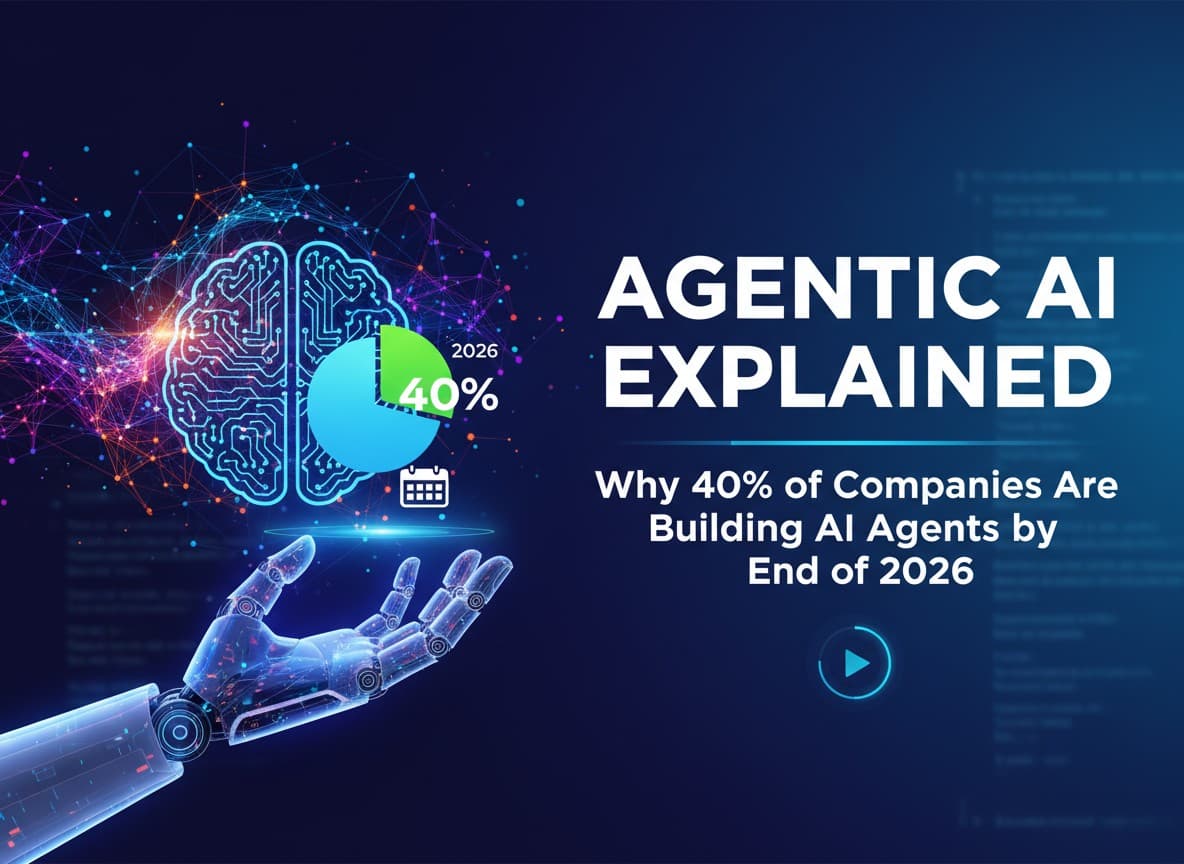
If you've been following AI news, you've probably heard the term "agentic AI" thrown around. It's the buzzword of 2026, and for good reason: Gartner predicts that 40% of enterprise applications will use AI agents by the end of this year, up from less than 5% in 2025. For more, see why AI agents are struggling to scale in enterprise.
That's not incremental growth—that's a revolution.
But what exactly is agentic AI? Why are companies racing to build agents? And should you care? Let's break it down.
What Is Agentic AI?
Here's the simplest definition: Agentic AI refers to AI systems that can autonomously take actions to achieve a goal, rather than just responding to prompts.
The Difference Between AI Assistants and AI Agents
- AI Assistant (e.g., ChatGPT, Claude): You ask a question. It gives you an answer. You take action.
- AI Agent (e.g., OpenClaw, Copilot Agents): You set a goal. It figures out the steps, uses tools, and takes action on your behalf.
Example:
- Assistant: "Draft an email to my team about the project update."
- Agent: "Summarize the project status, email the team, schedule a follow-up meeting, and add it to my calendar."
See the difference? Agents don't just think—they do.
How AI Agents Work
An AI agent typically has three core capabilities:
1. Reasoning and Planning
The agent understands your goal, breaks it into sub-tasks, and figures out the order of operations. This is where OpenAI's o1 and o3 reasoning models shine—they use "chain-of-thought" processing to think through problems step-by-step.
2. Tool Use
Agents can interact with external tools: your email, your calendar, databases, APIs, web browsers, code editors, etc. This is what makes them powerful—they're not limited to generating text.
3. Autonomous Execution
Once the agent has a plan, it executes it—without you manually clicking through each step. It might send emails, update spreadsheets, pull data from APIs, and compile reports, all while you're doing something else.
Why Companies Are Going All-In on Agents
The business case for AI agents is simple: they save time and reduce busywork. For more, see the honest truth about AI agents in business.
Real-World Use Cases
Here are examples from IBM, Microsoft, and Google Cloud reports:
- Customer support: An agent reads a support ticket, checks the knowledge base, drafts a response, and escalates to a human if needed.
- Sales and CRM: An agent monitors lead activity, sends follow-up emails, schedules demos, and updates Salesforce automatically.
- Software development: An agent writes code, runs tests, opens pull requests, and summarizes changes for review. (Tools like Cursor, Lovable, and Replit already do this.)
- Data analysis: An agent pulls data from multiple sources, cleans it, generates insights, and creates a presentation—all from a single prompt.
Microsoft says teams using Copilot Agents can launch global campaigns in days instead of weeks, with AI handling data crunching while humans focus on strategy.
The Big Players in Agentic AI
Every major tech company is building agent platforms:
1. Microsoft Copilot Agents
Microsoft's Wave 2 update introduced Copilot Agents, which let users build custom AI assistants inside Excel, PowerPoint, Teams, and Outlook. These agents automate workflows like report generation, meeting scheduling, and data analysis.
2. Google Gemini Agents
Google's Gemini 2.5 and 3.0 Pro models are built for long-context tasks, with context windows up to 2 million tokens. This lets agents read entire codebases, documents, or email threads before taking action.
3. OpenAI (with OpenClaw's Creator on Board)
OpenAI recently hired Peter Steinberger, the creator of OpenClaw, to lead their "next generation of personal agents." Expect major agent-focused announcements from OpenAI in 2026. For more, see OpenClaw as a real-world example of an AI agent.
4. OpenClaw (Open Source)
OpenClaw is the open-source darling of the agent world. It runs locally, integrates with 50+ services, and lets you build custom workflows without vendor lock-in. It's also causing Mac shortages because everyone wants to run it.
The Limitations: Why Agents Aren't Perfect Yet
Here's the reality check: AI agents make too many mistakes for high-stakes tasks.
From IBM's 2026 AI trends report:
"AI agents make too many mistakes for businesses to rely on them for any process involving big money."
Common Problems
- Hallucinations: Agents sometimes confidently do the wrong thing because they misinterpret context.
- Security risks: Giving an agent access to your email, files, and APIs is powerful—but also risky if it's compromised. (See our article on OpenClaw security issues.)
- Lack of judgment: Agents are great at executing plans, but terrible at deciding whether the plan makes sense in the first place.
This is why most companies are deploying agents for low-risk, repetitive tasks first—things like scheduling, data entry, and basic customer support.
What's Next for Agentic AI?
The next 12 months will be critical. According to MIT Technology Review, we're likely to see:
1. Smaller, Domain-Specific Agents
Instead of one giant agent that does everything, we'll have specialized agents for specific tasks—one for coding, one for customer support, one for data analysis. This approach is more reliable and easier to manage.
2. Multimodal Agents
Agents will move beyond text. They'll understand images, audio, and video, and interact with the world more like a human. Google's Gemini 2.5 and OpenAI's GPT-5 multimodal features are leading this shift.
3. AI Agents for Scientific Discovery
In 2026, AI won't just summarize research papers—it'll generate hypotheses and control lab experiments. This is huge for fields like drug discovery, materials science, and climate research.
4. Better Human-AI Collaboration
The future isn't "AI replaces humans"—it's "AI handles the grunt work, humans make the decisions." Microsoft's vision of a three-person team launching global campaigns with AI agents is a good example.
Should You Be Using AI Agents?
If you're a business: Yes—start experimenting now. Even if agents aren't perfect, automating 70-80% of repetitive tasks is a massive productivity boost. Just don't deploy them for mission-critical processes yet.
If you're an individual: Maybe. If you're a developer, data analyst, or power user, tools like OpenClaw, Cursor, or Microsoft Copilot can save you hours per week. For casual users, ChatGPT or Google Gemini are still the better choice.
The Takeaway
Agentic AI is the next evolution of automation. It's not just about smarter chatbots—it's about software that can act on your behalf, using the tools you already use, without constant hand-holding.
By the end of 2026, nearly half of enterprise apps will have agent capabilities. That's not hype—that's a fundamental shift in how we work.
If you're not exploring AI agents yet, now's the time to start.
Want to dive deeper? Check out our coverage of OpenClaw joining OpenAI, the Mac shortage caused by local AI, and Apple's March event where Siri might finally get smarter.
Sources: