OpenClaw Creator Joins OpenAI - What This Means for Personal AI Agents
Peter Steinberger, creator of the viral OpenClaw AI agent, is joining OpenAI to lead personal AI development. Here's what it means for the future of AI agents and open source.
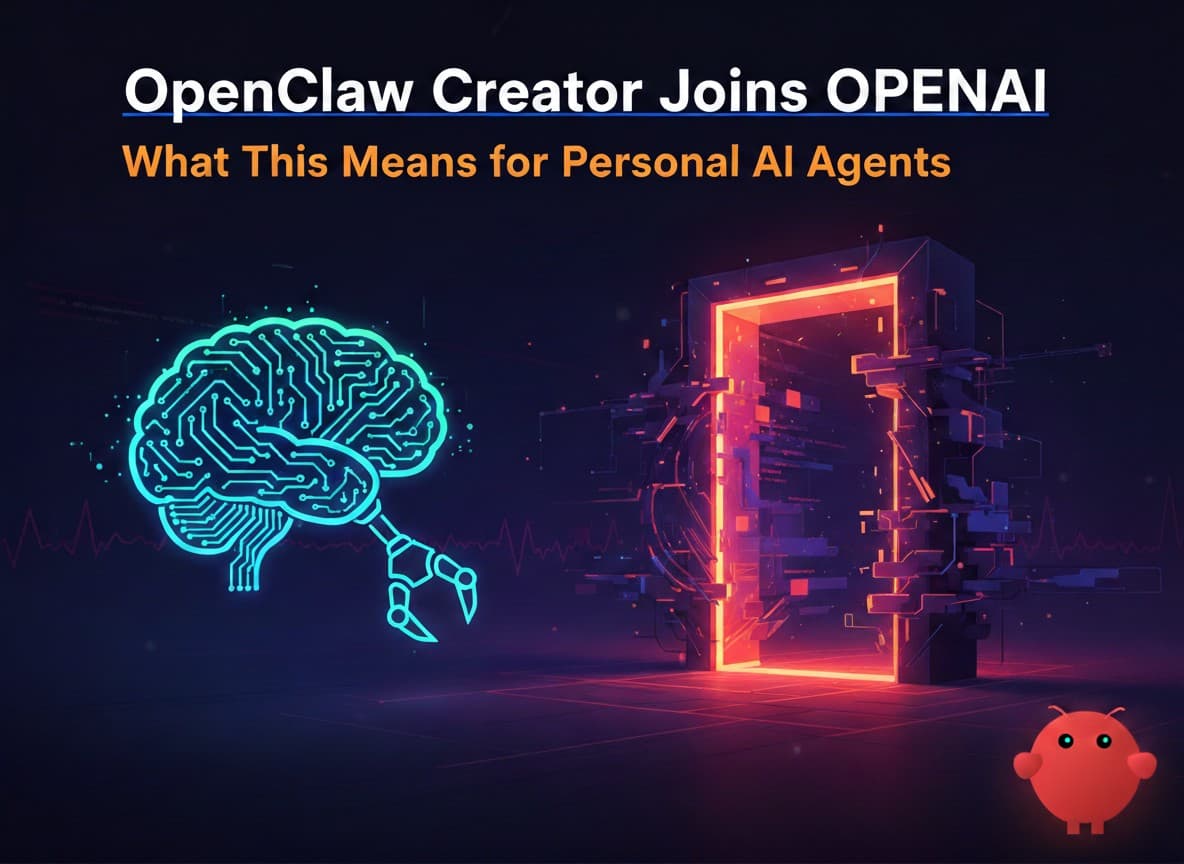
The AI world just got a major shakeup. Peter Steinberger, the creator of OpenClaw, is joining OpenAI to lead the development of the next generation of personal AI agents. Sam Altman himself confirmed the news on X (formerly Twitter), and the implications are massive for anyone interested in AI assistants.
The OpenClaw Phenomenon
If you haven't heard of OpenClaw yet, here's the quick version: it's an open-source personal AI assistant that runs locally on your machine, remembers context across conversations, and can actually do things on your computer. Think of it as having a digital assistant that knows your workflow, integrates with 50+ services, and doesn't send your data to the cloud.
The project exploded in popularity in late January 2026, racking up over 145,000 GitHub stars in a matter of weeks. That's not just hype—it's a signal that people are hungry for AI agents they can control and customize. For more, see how OpenClaw grew to 145K GitHub stars.
Why Steinberger Chose OpenAI Over Building His Own Empire
Here's where it gets interesting. Steinberger, an Austrian developer, had offers on the table to turn OpenClaw into a standalone company. Big money, big opportunities. But he turned them down. For more, see what OpenClaw is and what it can do.
In his announcement post, Steinberger wrote: "It's not really exciting for me." Instead, he's joining OpenAI to work on something bigger: building personal AI agents that scale to millions of users while keeping OpenClaw alive as an open-source project.
Sam Altman assured the community that OpenClaw will "live in a foundation as an open source project that OpenAI will continue to support." This is a huge win for open-source AI—it means the project won't die or get acquired into oblivion.
What This Means for the Future of AI Agents
Steinberger's move to OpenAI signals a broader trend: personal AI agents are the next frontier. We've had chatbots for years, but agents that can actually take action, integrate with your tools, and work autonomously? That's still bleeding edge.
With OpenAI's resources and Steinberger's vision, we're likely to see: — learn more: OpenAI's $200M Pentagon deal and what's driving growth
- Better integration between ChatGPT and your daily workflows
- More sophisticated agent capabilities that go beyond text generation
- Open-source foundations that let the community build on top of OpenAI's work
This isn't just about one developer joining a big company. It's about the convergence of open-source innovation and enterprise-scale AI development.
The Bigger Picture: Agentic AI Is Taking Over
OpenClaw's success is part of a larger wave. Gartner predicts that 40% of enterprise applications will use AI agents by the end of 2026, up from less than 5% in 2025. That's explosive growth.
Companies like Microsoft (with Copilot), Google (with Gemini agents), and now OpenAI (with Steinberger on board) are racing to build the agent layer that sits between you and your digital tools. The question isn't if AI agents will become mainstream—it's how soon.
What Happens to OpenClaw Now?
The good news: OpenClaw isn't going anywhere. It'll continue as an open-source project under a foundation structure, with OpenAI providing support. The community can keep building, contributing, and customizing.
For developers and AI enthusiasts, this is actually the best outcome. You get the innovation and community energy of open source, backed by one of the most well-funded AI companies in the world.
Should You Try OpenClaw?
If you're curious about running your own AI agent locally, OpenClaw is worth exploring. It's still early days—there have been security issues (more on that in our OpenClaw security update article)—but the project is actively maintained and improving fast.
Just be aware: running AI agents locally requires decent hardware. If you're on a Mac, you'll want at least 16GB of unified memory, preferably more. (Speaking of which, OpenClaw demand is actually causing Mac shortages right now—we cover that story in another post.)
The Takeaway
Peter Steinberger joining OpenAI is a watershed moment for personal AI agents. It shows that open-source innovation can attract top-tier talent and enterprise support without sacrificing its community roots.
If you're following AI trends, this is one to watch. The next year will be all about agents—and OpenClaw just became a blueprint for how open source and big tech can work together.
Want to stay on top of AI news like this? Subscribe to our newsletter for weekly updates on the latest in AI tools, Apple tech, and everything in between.
Sources: