OpenAI's $200M Pentagon Deal: Why Users Are Ditching ChatGPT and What It Means for AI
In early 2026, OpenAI's $200M Pentagon deal ignited an AI ethics firestorm. Anthropic refused the same contract. Claude's daily users surged 183%. Here's what happened.
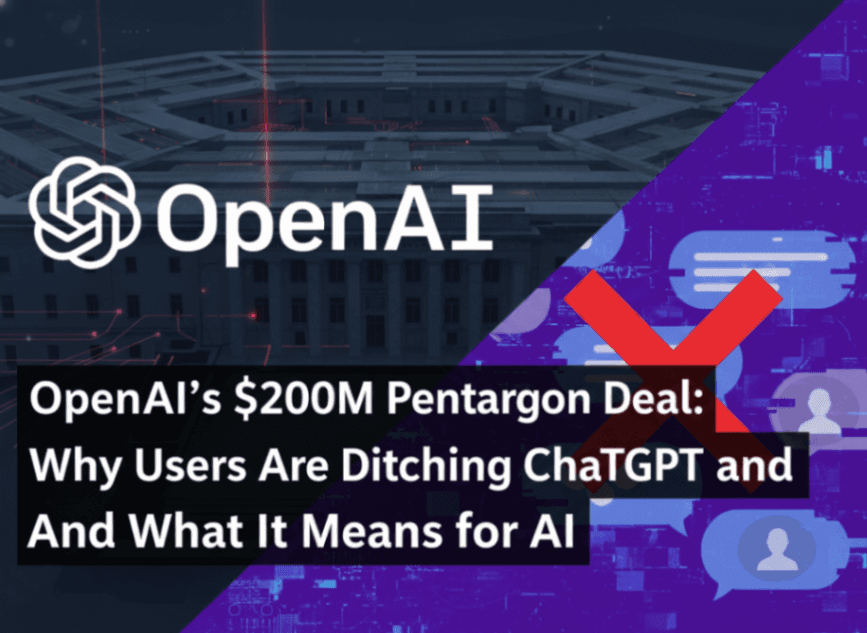
In the span of a few weeks in early 2026, the AI industry experienced one of its most consequential ethical reckonings to date. What started as a quiet government contract negotiation exploded into a full-blown public controversy — one that reshuffled the competitive landscape of consumer AI, catapulted Claude to the top of the App Store, and forced OpenAI's Sam Altman to publicly admit his company moved too fast. This is the story of how a $200 million Pentagon deal became a defining moment for AI ethics, corporate trust, and the future of who gets to shape these powerful systems.
The Deal That Divided the AI Industry
On February 28, 2026, OpenAI announced it had signed a $200 million contract with the U.S. Department of Defense — referred to under the current administration as the Department of War. The agreement, published publicly at openai.com/index/our-agreement-with-the-department-of-war/, authorized the Pentagon to use OpenAI's models for a sweeping range of applications under the broad umbrella of "all lawful purposes."
The reaction was immediate and fierce. Privacy advocates, AI researchers, longtime ChatGPT users, and civil liberties organizations condemned the deal. The Electronic Frontier Foundation (EFF) called the language in the agreement full of "weasel words" that won't prevent AI-powered surveillance. On Reddit and X, "Cancel ChatGPT" campaigns went viral. Thousands of users posted step-by-step guides for deleting their OpenAI accounts and migrating to Claude.
But to understand why this deal landed like a grenade, you have to understand what happened before OpenAI even entered the picture.
How We Got Here: Anthropic's Original Pentagon Contract
Before OpenAI secured its deal, Anthropic had its own contract with the Department of Defense. The arrangement allowed the Pentagon to deploy Claude on classified networks — a carefully scoped agreement that Anthropic believed fell within its ethical boundaries. The company had negotiated specific use-case restrictions, consistent with its long-standing commitment to AI safety.
Then the Pentagon pushed for more.
According to reporting from the Financial Times and CNBC, the Department of War demanded that Anthropic amend the contract to allow Claude to be used for "all lawful purposes" — a phrase that critics note is deliberately vague and could encompass mass domestic surveillance, autonomous weapons targeting, and other applications Anthropic had explicitly ruled out.
Anthropic's response was unambiguous: no.
Why Anthropic Said No
Dario Amodei, Anthropic's CEO, rejected the Pentagon's expanded terms outright. His reasoning was rooted not in politics but in the company's foundational commitments: Anthropic will not allow Claude to be used for autonomous weapons systems or mass domestic surveillance. Period.
This was not a PR move — it was a decision that cost the company a government contract worth tens of millions of dollars. The Pentagon blacklisted Anthropic and terminated the agreement entirely.
For many observers, this was exactly the kind of principled stand that the AI industry has desperately needed. AI safety has always been Anthropic's core differentiator, but it had often been dismissed as theoretical hand-wringing. The Pentagon standoff made it concrete: Anthropic was willing to walk away from serious money to maintain its ethical boundaries.
The decision was not without risk. Losing a major government contract is a significant financial blow, especially in an industry where compute costs are enormous and the race for enterprise clients is relentless. But the public's response to Anthropic's position would soon rewrite the calculus entirely.
OpenAI Steps In — And Quickly Regrets It
With Anthropic out, Sam Altman and OpenAI stepped into the void. The $200 million Pentagon deal was signed quickly — and by Altman's own admission, perhaps too quickly.
Within days of the announcement, Altman publicly acknowledged that the deal "looked opportunistic and sloppy" and "shouldn't have been rushed." It was a remarkable admission for a CEO of one of the world's most valuable AI companies. The statement confirmed what many critics had suspected: OpenAI had prioritized the contract over careful deliberation about its implications.
This was particularly jarring because OpenAI had previously stated it would not allow its models to be used for military applications. The Pentagon deal represented a direct reversal of that stance — and users noticed. The backlash was not just from AI ethics advocates. It came from everyday ChatGPT subscribers who had trusted the company's earlier commitments.
Under pressure, OpenAI amended the contract to include some restrictions on surveillance use cases. But for many users, the damage was already done. The amendments felt reactive rather than principled — a company papering over a mistake rather than owning it.
The User Backlash: How ChatGPT Lost Its Crown
The public's response to OpenAI's Pentagon deal was swift and measurable. Within days of the announcement:
- "Cancel ChatGPT" campaigns spread virally across Reddit and X, with users sharing detailed guides on how to delete accounts and export data.
- Claude hit #1 on Apple's App Store, dethroning ChatGPT in one of the most symbolic competitive shifts in AI history.
- Claude's daily active users jumped 183%, reaching 11.3 million users across iOS and Android — figures reported by Axios and corroborated by Fortune.
- ChatGPT's market share of AI app installs fell from 68% in Q4 2025 to just 52% in early March 2026.
- Claude now holds approximately 23% of new AI app installs, a figure that would have seemed unthinkable six months ago.
This is a seismic shift. For years, ChatGPT dominated consumer AI so thoroughly that "ChatGPT" became synonymous with "AI chatbot" in the same way "Google" became synonymous with "search." Losing 16 percentage points of market share in a matter of weeks is not a blip — it is a structural realignment.
And it happened not because Claude released a flashy new feature or ran a clever ad campaign. It happened because users chose to vote with their subscriptions over a question of ethics. That is unprecedented in the AI industry. For more, see GPT-5.4 vs Claude vs Gemini: who's winning the AI race.
We covered Claude's App Store milestone in detail in our piece on Claude Beats ChatGPT on the App Store, and we have done a deep-dive comparison in our ChatGPT vs Claude vs Gemini breakdown.
What OpenAI's Contract Actually Says (and What Critics Say Is Missing)
The contract, published on OpenAI's website, authorizes the Pentagon to use OpenAI's models for "all lawful purposes." On the surface, that sounds reasonable. "Lawful" should mean safe, right?
Not according to civil liberties experts. The EFF's analysis pointed out that "lawful" is doing enormous heavy lifting in that phrase. Much of what critics consider the most dangerous potential uses of AI — building mass surveillance databases, automating the targeting of individuals for deportation or criminalization, or feeding autonomous weapons systems — can be framed as "lawful" under existing law. The word "lawful" does not mean "ethical," and it does not mean "safe."
The amendments OpenAI added after the backlash restrict some specific surveillance applications, but critics argue the language remains too vague to provide meaningful protections. The EFF was explicit: the amended deal still contains loopholes large enough to drive a surveillance apparatus through.
This connects to broader concerns explored in Why AI Agents Aren't Scaling in Enterprise — governance frameworks have simply not kept pace with deployment speed, and vague contractual language is part of that problem.
What Happens Next: Anthropic Back at the Table
Here is where the story takes another surprising turn. As of March 5, 2026, Anthropic was reportedly back in negotiations with the Pentagon — this time under different terms, according to the Financial Times via CNBC.
The new discussions appear to be happening on Anthropic's terms, not the government's. The original demand — "all lawful purposes" with no meaningful safeguards — is apparently off the table. Instead, the negotiations are reportedly focused on specific, scoped use cases that Anthropic can support without compromising its safety principles.
If a new deal emerges, it could represent exactly the kind of model the AI industry needs: government contracts with built-in ethical guardrails, negotiated by companies willing to walk away if those guardrails are removed. That is a very different precedent than what OpenAI set — and a potentially healthier one for the long-term relationship between AI companies and their government clients.
What This Means for You: Should You Switch to Claude?
If you are a ChatGPT user weighing whether to make the switch, here is an honest assessment from both sides.
Reasons to consider switching:
- If you prioritize using AI tools from companies with clear, enforced ethical boundaries, Anthropic's public stance on autonomous weapons and mass surveillance is a strong differentiator.
- Claude 3.5 Sonnet and Claude Opus are genuinely competitive with GPT-4o on most benchmarks, and many users find Claude's responses more nuanced for complex analytical and writing tasks.
- Claude's free tier has become substantially more capable following the user surge, as Anthropic has invested in scaling infrastructure to handle the influx.
- Anthropic's free active users are up more than 60% year-to-date, suggesting strong organic growth that is not purely controversy-driven.
Reasons to stay with ChatGPT (or use both):
- OpenAI's ecosystem — including GPT-4o, DALL-E, and deep integrations with Microsoft 365 — is mature and broad.
- OpenAI did amend its Pentagon deal after criticism, demonstrating some responsiveness to public pressure.
- Existing ChatGPT workflows, custom GPTs, and API integrations represent real switching costs for power users and developers.
- Both products are advancing rapidly, and any capability gap can close quickly in this environment.
The honest answer is that the right choice depends on what you value. But the market's verdict is increasingly clear: a significant and growing segment of AI users care about who builds their tools and what those tools are ultimately used for.
For a detailed feature-by-feature breakdown, see our Claude Opus 4.6 Review.
The Bigger Picture: AI Ethics Is Now a Competitive Advantage
The OpenAI Pentagon controversy represents something genuinely new in the history of technology: a company's ethical stance becoming a measurable competitive advantage almost overnight.
Tech companies have long made vague commitments to "responsible AI" that rarely cost them anything concrete. Anthropic's decision to lose a government contract rather than compromise its safety principles is categorically different. It was a real sacrifice, with real financial consequences — and the market rewarded it decisively.
This creates a new dynamic for the entire AI industry. If users are willing to migrate en masse in response to perceived ethical failures, then AI companies that treat safety as a PR exercise are taking a genuine business risk. The 183% jump in Claude's daily active users is not just a data point — it is a market signal that the industry cannot afford to ignore.
It also creates pressure on regulators and government agencies. The Pentagon's original demand — blanket "all lawful purposes" authorization — was rejected by Anthropic, embarrassed OpenAI, and triggered a public relations firestorm that reached Congress. Future government AI procurement may need to be more specific, more transparent, and more accountable.
The growing rift in the AI industry over military applications is real and accelerating. Different companies are making different bets about where the boundaries of acceptable use should lie — and users are now actively rewarding the companies that draw those lines in places they agree with. This is how markets are supposed to work, and it is a genuinely hopeful sign for the long-term development of AI that remains accountable to the people who use it.
For more context on the industry dynamics at play, see our coverage of OpenClaw Creator Joins OpenAI and our ongoing analysis in Why AI Agents Aren't Scaling in Enterprise.
FAQ
Why did users leave ChatGPT for Claude?
The primary trigger was OpenAI's $200 million Pentagon contract, signed in late February 2026, which authorized AI use for "all lawful purposes" — language critics argued could include mass surveillance and autonomous weapons. This reversed OpenAI's prior stated position against military use. In contrast, Anthropic had rejected the same contract terms and lost its own Pentagon deal rather than compromise its safety principles. Users viewed Anthropic's stance as more trustworthy, leading to viral "Cancel ChatGPT" campaigns, a 183% spike in Claude's daily active users, and Claude reaching number one on the Apple App Store.
What did OpenAI agree to with the Pentagon?
OpenAI signed a $200 million contract with the U.S. Department of Defense covering "all lawful purposes." The full agreement was published publicly at openai.com/index/our-agreement-with-the-department-of-war/. After significant public backlash — including CEO Sam Altman admitting the deal "looked opportunistic and sloppy" — OpenAI amended the contract to restrict some surveillance use cases. Critics, including the EFF, argue the amended language still contains significant loopholes and does not provide adequate protections against AI-powered surveillance or weapons applications.
Is Claude safer than ChatGPT?
The answer depends on how you define safety. In terms of company policy on high-risk applications, Anthropic has taken a more explicitly restrictive stance: Claude will not be used for autonomous weapons or mass domestic surveillance — a commitment Anthropic backed with real financial consequences when it walked away from the Pentagon contract rather than accept those terms. OpenAI has policies against harmful uses but demonstrated a willingness to sign a broad military contract that it later had to amend under public pressure. From a pure product perspective, both models maintain extensive safety guardrails. But on the question of institutional commitment to ethical limits, Anthropic's actions in early 2026 set a higher and more visible bar.