Perplexity vs ChatGPT 2026: Smarter Choice?
Perplexity vs ChatGPT in 2026: a practical guide for Indian users comparing search accuracy, writing quality, pricing, research depth, and the best fit for students, creators, and professionals.
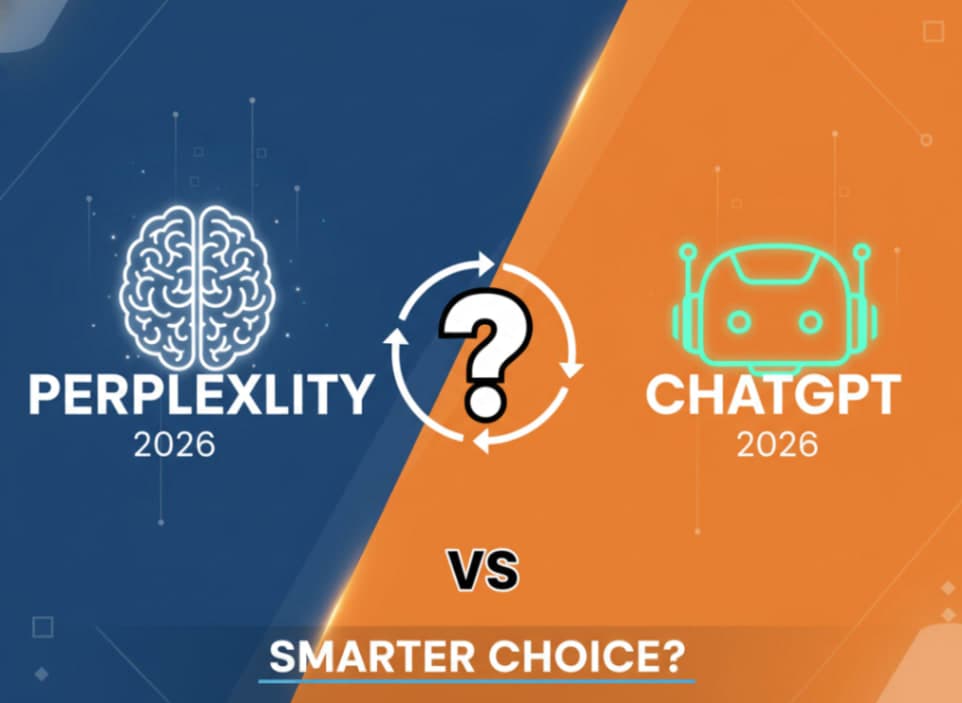
If you are trying to decide between Perplexity AI and ChatGPT in 2026, the short answer is simple: they are both useful, but they are not useful in the same way.
Perplexity is better when you want fast research, current web-backed answers, source links, and a cleaner way to compare information across sites. ChatGPT is better when you want stronger writing help, brainstorming, editing, coding support, step-by-step explanations, and a more flexible all-purpose assistant.
That is why the real question is not just "Perplexity AI vs ChatGPT: which is better?" It is "better for what?"
For Indian users, that distinction matters even more. If you are paying roughly Rs 1,700 to Rs 2,000 per month for a premium AI plan after currency conversion and taxes, you do not want to subscribe to the wrong tool. Students want better study help. Freelancers want better writing and research. Founders want fast summaries and decision support. Creators want both research depth and usable copy.
In this guide, we will break down where Perplexity wins, where ChatGPT wins, how pricing feels from India, and which tool makes more sense depending on your work.
Perplexity vs ChatGPT: The quick verdict
If you want the fastest answer possible, here is the practical verdict:
- Choose Perplexity if your work starts with searching, verifying, comparing, and citing sources.
- Choose ChatGPT if your work starts with creating, rewriting, explaining, planning, or coding.
- Choose both only if AI is central to your daily workflow and you will actually use one for research and the other for production.
Perplexity feels like an AI-first answer engine. It takes the normal search process and compresses it. Instead of opening ten tabs and guessing which summary is reliable, you get one synthesized answer with linked sources.
ChatGPT feels more like a versatile assistant. It can still help with research, but its real strength is what happens after you know the answer. It helps you write the article, clean up the email, turn notes into a strategy, generate content angles, debug code, or explain something clearly.
If you already read our broader breakdown of Best AI Tools in 2026: The Complete Guide for Indian Users, this comparison sits inside that bigger decision: do you need a specialist for research, or a generalist for everything?
What Perplexity does better than ChatGPT
Perplexity's biggest advantage is trust through visibility. When it answers a question, it usually shows where the answer came from. That changes user behaviour in a good way. You are less likely to blindly copy an answer, and more likely to verify it quickly.
That makes Perplexity especially strong for these tasks:
1. Fast research with live web context
If you want to know the latest product launch, policy change, funding round, software update, or market trend, Perplexity is usually faster to trust because source links are front and center. For journalists, marketers, students, and agency teams, this matters.
2. Source-backed summaries
Perplexity is good at compressing multiple articles, forum threads, and official pages into one readable answer. You still need judgment, but the workflow is efficient. It reduces the time spent jumping between tabs.
3. Better first step for buyers and decision-makers
If you are comparing laptops, AI tools, software plans, or technical standards, Perplexity often gives you a cleaner starting map. That makes it useful before making a buying decision. If you liked our article on ChatGPT vs Gemini for Studying: Best for Indian Students (2026), think of Perplexity as even more useful when the first task is collecting current facts before choosing a tool.
4. Less friction for current-events queries
ChatGPT can absolutely handle many current topics depending on model and connected tools, but Perplexity is built around that experience. For users who mainly want answers anchored to the open web, Perplexity often feels more direct.
Still, Perplexity has limits. It can summarize and compare well, but it is not automatically better at deep writing, nuanced editing, or long creative generation. It is strongest when your workflow begins with "find and verify."
What ChatGPT does better than Perplexity
ChatGPT wins on range.
If Perplexity is the better research front-end, ChatGPT is the better workhorse after the research phase. It handles more kinds of tasks well, and it usually feels stronger when you want an output you can actually use after a few iterations.
1. Writing and rewriting
Need a blog outline, email draft, landing page copy, script, cold outreach template, or summary rewritten for tone? ChatGPT is usually better at this than Perplexity. It is more flexible, easier to steer, and better at taking feedback.
2. Brainstorming and ideation
ChatGPT is stronger when you want ten campaign ideas, five hooks for a YouTube video, three positioning angles for a product, or a simpler explanation of a technical topic. It behaves more like a collaborator than a search layer.
3. Coding and structured problem-solving
For debugging, drafting code, generating formulas, or walking through logic, ChatGPT is usually ahead in usability. Developers and power users tend to get more mileage out of it because it can move between plain language and structured output quickly.
4. Better conversational memory inside a task
ChatGPT generally feels better in back-and-forth iteration. You can refine, expand, simplify, and redirect the answer without the tool feeling like it always wants to return to search behaviour.
That is why many users who start with Perplexity for research still end up using ChatGPT for the actual deliverable. A common workflow is: research in Perplexity, create in ChatGPT.
If you want a broader creator-focused stack, our guide to 25 Best AI Apps for iPhone in India (2026) covers where mobile-first users may prefer app ecosystems over desktop-heavy workflows.
Accuracy, hallucinations, and trust
Neither tool deserves blind trust.
Perplexity often feels more accurate because it cites sources, but source links do not magically make a summary perfect. It can still over-compress, misread nuance, or blend outdated and current sources into one confident answer. You still have to open the links, especially for pricing, regulation, health, finance, and technical claims.
ChatGPT has the opposite problem. It can sound more polished than it deserves. When it gets something wrong, the answer may still read smoothly enough that a casual user misses the problem.
So which is better for accuracy?
- For current, web-based factual questions, Perplexity usually has the edge.
- For reasoning through a task once the facts are known, ChatGPT often feels stronger.
- For high-stakes decisions, neither should be your only source.
That is also why comparison articles like DeepSeek vs ChatGPT: Which AI Is Actually Better in 2026? (Tested) matter. "Best AI" is almost always context-dependent. The tool that gives the best answer to a current-events question may not be the best tool for writing, coding, or long-term productivity.
Perplexity Pro vs ChatGPT Plus: Which is better value in India?
This is where the India angle becomes real.
Globally, both premium plans are typically positioned at around $20 per month, but what Indian users feel is the converted cost, card charges, and GST where applicable. In practice, your monthly cost can land somewhere around Rs 1,700 to Rs 2,000 or more depending on exchange rate swings and taxes.
That is not cheap if you are a student, solo creator, or bootstrapped founder.
So which one is the better value?
Perplexity is better value if:
- You do heavy daily research
- You compare products, tools, or news constantly
- You care more about linked sources than long-form writing quality
- You want to replace a chunk of traditional searching
ChatGPT is better value if:
- You write every day
- You use AI for brainstorming, editing, and planning
- You need help with code, spreadsheets, and structured thinking
- You want one AI tool to cover more job types
For most Indian users paying for only one subscription, ChatGPT is usually the safer value pick because it covers more surface area. You can use it for work, study, writing, strategy, and creativity. Perplexity is excellent, but narrower.
That said, if your job is research-heavy, Perplexity can save enough time to justify the spend. Analysts, recruiters, consultants, editors, and content researchers may get more direct ROI from it.
Best use cases: who should choose what?
Students
If you mainly need concept explanations, summaries, writing help, and study plans, ChatGPT is usually the better choice. If you do a lot of research projects and need sources quickly, Perplexity becomes more attractive.
Content creators and bloggers
Use Perplexity to gather current context and competitor information. Use ChatGPT to turn that into outlines, scripts, hooks, article drafts, and repurposed social posts. If you can only pay for one, ChatGPT usually wins.
Professionals and founders
Need market scans, vendor comparisons, or fast briefings before meetings? Perplexity is fantastic. Need strategy docs, pitch rewrites, outreach drafts, and workflow support? ChatGPT is stronger.
Developers and technical users
ChatGPT is generally more useful because coding, debugging, and iterative problem-solving are bigger parts of the workflow. Perplexity is still useful for documentation lookup and quick research.
So, Perplexity AI vs ChatGPT: which is better in 2026?
Here is the honest answer.
Perplexity is better for discovering and verifying information. ChatGPT is better for turning information into work.
If your day starts with search, comparisons, and source-checking, Perplexity may feel like the smarter tool. If your day starts with writing, planning, building, or explaining, ChatGPT is the better pick.
For most Indian users choosing just one paid subscription in 2026, ChatGPT is the better overall buy because it is more flexible. For research-heavy users, Perplexity may be the sharper specialist.
That means the winner depends on whether you value breadth or retrieval.
If you want one line: Perplexity helps you know faster. ChatGPT helps you do more.
FAQ
Is Perplexity better than ChatGPT for research?
Yes, for many current web-based research tasks, Perplexity is better because it surfaces source links clearly and is designed around fast answer discovery. But you should still verify important claims directly from the source pages.
Is ChatGPT better than Perplexity for writing?
Yes. ChatGPT is usually better for writing, rewriting, brainstorming, and iterative editing. It is more flexible when you want an output shaped to a specific tone, structure, or audience.
Which is cheaper for Indian users: Perplexity or ChatGPT?
They are usually priced in the same broad premium tier globally, so for Indian users the real monthly cost is often similar after exchange rates and taxes. The better value depends less on list price and more on whether you need research depth or broader everyday utility.