GPT-5.4 vs Claude 4.6 vs Gemini 3.1 Pro: Best AI for India? (2026)
GPT-5.4 vs Claude Sonnet 4.6 vs Gemini 3.1 Pro: The March 2026 AI Model Showdown March 2026 delivered something rare in the AI industry: three major frontier mo
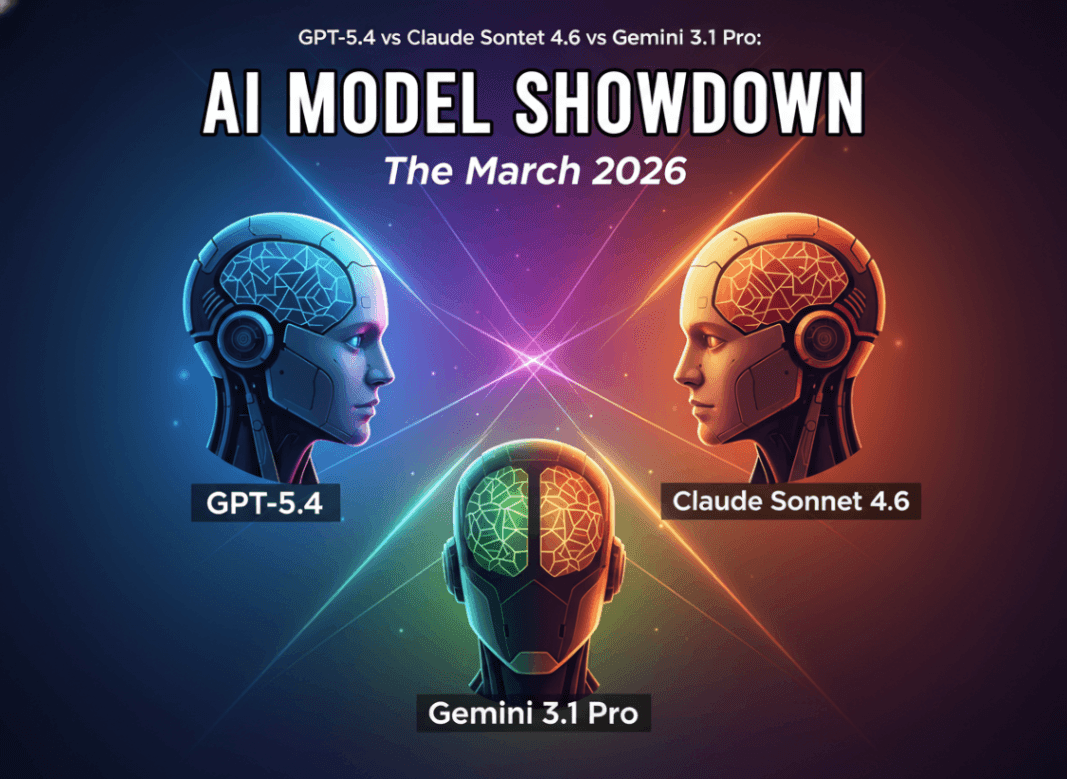
March 2026 delivered something rare in the AI industry: three major frontier model releases packed into a single month. OpenAI dropped GPT-5.4, Anthropic followed with Claude Sonnet 4.6, and Google answered with Gemini 3.1 Pro. For developers, researchers, and businesses trying to pick the right model, the timing could not be more overwhelming — or more exciting.
This comparison cuts through the noise. We have pulled the verified benchmark numbers, analyzed the pricing, and laid out exactly which model wins in each category so you do not have to. Whether you are building an AI agent pipeline, processing legal documents, or generating video-aware content, the right model is here — you just need to know which one to reach for.
The Three Models at a Glance
| Model | Maker | Input Pricing | Context Window | Best For |
|---|---|---|---|---|
| GPT-5.4 | OpenAI | ~$2.50/1M tokens | 1M tokens | Knowledge work, computer use, tool use |
| Claude Sonnet 4.6 | Anthropic | Competitive with GPT-5.4 | 1M tokens (beta) | Expert-level tasks, agent workflows, long-context |
| Gemini 3.1 Pro | $2.00/1M tokens | 1M tokens | Reasoning, multimodal (video/audio), price-performance |
All three models now offer 1 million token context windows, which effectively removes context length as a differentiator. The real differences lie in reasoning depth, multimodal capability, agent performance, and how efficiently each model handles specific task types.
GPT-5.4: OpenAI's Most Factual Model Yet
Released on March 5, 2026, GPT-5.4 represents OpenAI's most significant factual accuracy leap in recent history. Available in ChatGPT, Codex, and via API (model IDs: gpt-5.4 and gpt-5.4-pro), this model was built with a clear mandate: reduce hallucinations and improve performance on high-stakes, real-world tasks.
What's New in GPT-5.4
The headline number is a 33% reduction in false claims compared to GPT-5.2. For anyone who has used previous GPT models in production and dealt with confident-sounding fabrications, this is a meaningful improvement. OpenAI has clearly prioritized truthfulness alongside raw capability.
On domain-specific benchmarks, GPT-5.4 shines where it counts:
- 91% on Harvey's BigLaw Bench — This benchmark tests document-heavy legal work, including contract review, precedent retrieval, and legal reasoning. A 91% score means GPT-5.4 is performing at or above junior associate level on legal tasks.
- 83% on GDPval — GDPval measures performance on knowledge work tasks that parallel what industry professionals do day-to-day. Hitting 83% means GPT-5.4 is genuinely competing with skilled human workers on structured knowledge tasks.
- 75% on OSWorld — OSWorld evaluates computer use: navigating UIs, operating desktop software, and completing multi-step tasks on a real computer. At 75%, GPT-5.4 surpasses human performance on this benchmark — a milestone that has direct implications for autonomous agents and RPA use cases.
Pricing and Context
GPT-5.4 comes in at approximately $2.50 per million input tokens and $20 per million output tokens, with a maximum output of 128K tokens per request. The 1M token context window is available, though the output ceiling is something to watch for long-form generation tasks.
Where GPT-5.4 Leads
GPT-5.4 is the clear winner for computer use, tool use, and knowledge work that demands factual precision. If you are building agents that need to operate software autonomously, or if you are deploying in legal, compliance, or research contexts where hallucinations are unacceptable, GPT-5.4 is the most credible choice from OpenAI's lineup to date.
Claude Sonnet 4.6: The Agent and Expert Specialist
Anthropic released Claude Sonnet 4.6 in late February and early March 2026, positioning it as the go-to model for expert-level tasks and complex agent workflows. If you have been following Anthropic's roadmap around agentic AI, Claude Sonnet 4.6 is the clearest embodiment of that vision yet.
What's New in Claude Sonnet 4.6
Sonnet 4.6 delivers meaningful upgrades in three areas: computer use, long-context reasoning, and agent planning. These are not incremental improvements — they represent a qualitative shift in how well the model handles tasks that require multi-step reasoning across large bodies of information.
The standout benchmark result is Claude Sonnet 4.6's 1,633 points on the GDPval-AA Elo benchmark — the highest score of the three models tested here. This benchmark focuses specifically on expert-level, high-value tasks: complex analysis, nuanced decision-making, and professional-grade output. Claude Sonnet 4.6 outperforms both GPT-5.4 and Gemini 3.1 Pro on this dimension.
The 1 million token context window (currently in beta) makes Sonnet 4.6 particularly powerful for:
- Analyzing entire codebases in a single pass
- Processing book-length documents without chunking
- Maintaining coherent reasoning across extended multi-turn agent sessions
Claude Opus 4.6: The Coding Benchmark Leader
Worth noting: Claude Sonnet 4.6's bigger sibling, Claude Opus 4.6, scores 80.8% on SWE-bench for coding — the highest coding score in this class of models. If raw coding performance is your priority, our full Claude Opus 4.6 review covers everything you need to know, and the Claude Opus 4.6 vs GPT-5.3 Codex comparison is worth reading for a direct head-to-head. For more, see the 2025 version of this comparison.
Pricing and Context
Claude Sonnet 4.6 is priced competitively with GPT-5.4, making it an easy comparison on cost. Where it differentiates is on the output side — Sonnet 4.6 handles complex, multi-step instructions more reliably, which can reduce the number of API calls needed for agentic tasks.
Where Claude Sonnet 4.6 Leads
For expert-level agent workflows, long-context reasoning, and tasks requiring sustained analytical depth, Claude Sonnet 4.6 is the benchmark leader. It is the model to reach for when you need an AI that can plan, reason across thousands of pages, and operate with minimal human correction across complex pipelines.
Gemini 3.1 Pro: The Multimodal Reasoning King
Google's Gemini 3.1 Pro arrives as the most versatile model in this trio — and in some key areas, the most capable. Released as an expressly upgraded version of the 3.x line with enhanced core intelligence, Gemini 3.1 Pro stands out on two fronts: reasoning benchmarks and native multimodal capability.
The Only True Multimodal Option
Gemini 3.1 Pro is the only model in this comparison that natively handles text, images, audio, and video in a single model. GPT-5.4 and Claude Sonnet 4.6 can process text and images, but video and audio understanding require workarounds or separate pipelines with those models. If your use case involves:
- Video content analysis or summarization
- Audio transcription with contextual reasoning
- Multi-format document processing
- Creative projects mixing media types
Gemini 3.1 Pro is the only frontier option that handles all of these natively, without stitching together multiple models.
Benchmark Leadership
On pure reasoning benchmarks, Gemini 3.1 Pro leads the pack:
- GPQA Diamond: 94.3% — This is the highest reasoning score of the three models. GPQA Diamond tests expert-level scientific and analytical reasoning. Gemini 3.1 Pro beats GPT-5.4 (92.8%) and Claude Opus 4.6 (91.3%) on this measure.
- ARC-AGI-2: 77.1% — ARC-AGI-2 is designed to test abstract reasoning and novel problem-solving. Gemini 3.1 Pro leads at 77.1%, ahead of GPT-5.4's 73.3%.
- SWE-bench Coding: 80.6% — Just 0.2 percentage points behind Claude Opus 4.6's class-leading 80.8%, Gemini 3.1 Pro is effectively tied for the top coding score.
For a broader look at how these models compare to earlier generations, the ChatGPT vs Claude vs Gemini comparison provides useful historical context. For more, see what's driving users away from ChatGPT.
Pricing and Context
At $2.00 per million input tokens, Gemini 3.1 Pro is the most affordable of the three frontier models. Combined with its leading benchmark scores on reasoning tasks, this makes it the strongest price-to-performance option in the comparison. The 1M token context window matches the competition.
Where Gemini 3.1 Pro Leads
Gemini 3.1 Pro leads on reasoning, multimodal tasks (the only viable option for video and audio), abstract problem-solving, and cost efficiency. If you are running high-volume inference workloads or need the best pure reasoning per dollar, Gemini 3.1 Pro is the pick.
Benchmark Showdown
Here is how the three models compare across the most important benchmarks available as of March 2026. Sources: LM Council benchmarks and published model cards.
| Benchmark | GPT-5.4 | Claude Sonnet 4.6 | Gemini 3.1 Pro | Leader |
|---|---|---|---|---|
| GPQA Diamond (reasoning) | 92.8% | 91.3%* | 94.3% | Gemini 3.1 Pro |
| ARC-AGI-2 (abstract reasoning) | 73.3% | — | 77.1% | Gemini 3.1 Pro |
| SWE-bench (coding) | — | 80.8%† | 80.6% | Claude Opus 4.6† |
| GDPval (knowledge work) | 83% | — | — | GPT-5.4 |
| GDPval-AA Elo (expert tasks) | — | 1,633 pts | — | Claude Sonnet 4.6 |
| OSWorld (computer use) | 75% | — | — | GPT-5.4 |
| BigLaw Bench (legal) | 91% | — | — | GPT-5.4 |
| Multimodal (video/audio) | No | No | Yes | Gemini 3.1 Pro |
*Claude Opus 4.6 score; Sonnet 4.6 is close behind. †Claude Opus 4.6 result — Sonnet 4.6 coding scores are slightly lower but competitive.
For additional benchmark context, AceCloud's model comparison and Evolink's March 2026 analysis provide further data points.
Which Model Should You Use?
For Coding and Software Development
Best pick: Claude Opus 4.6 / Sonnet 4.6, with Gemini 3.1 Pro as a close second.
Claude Opus 4.6's 80.8% SWE-bench score makes it the top coding model in this class. Sonnet 4.6 is slightly behind but significantly cheaper, making it the better default for most development workflows. Gemini 3.1 Pro at 80.6% is essentially tied and worth considering if you are already in the Google ecosystem.
For Research and Reasoning
Best pick: Gemini 3.1 Pro.
The highest GPQA Diamond score (94.3%) and ARC-AGI-2 leadership make Gemini 3.1 Pro the top choice for scientific analysis, complex problem-solving, and tasks requiring deep analytical reasoning.
For Agentic Workflows and Complex Planning
Best pick: Claude Sonnet 4.6.
With the best GDPval-AA Elo score and purpose-built improvements for agent planning and long-context reasoning, Claude Sonnet 4.6 is the strongest option for multi-step agent pipelines. The model's ability to maintain coherent planning across extended sessions is unmatched in this comparison. For more on how agentic AI is reshaping enterprise workflows, see our piece on agentic AI explained.
For Computer Use and Automation
Best pick: GPT-5.4.
At 75% on OSWorld — above human-level performance — GPT-5.4 is the clear leader for tasks that involve operating software, navigating UIs, and automating desktop workflows.
For Multimodal Applications (Video, Audio, Images)
Best pick: Gemini 3.1 Pro — the only option.
If you need video or audio processing in the same model pipeline as text reasoning, Gemini 3.1 Pro is the only choice among the three. GPT-5.4 and Claude Sonnet 4.6 do not offer native video or audio understanding at this level.
For Writing and Content Generation
All three models perform well on structured writing tasks. Claude Sonnet 4.6 tends to produce the most nuanced, tonally consistent long-form content. GPT-5.4's factual improvements make it reliable for research-backed articles. Gemini 3.1 Pro handles multi-format source material well if your workflow includes diverse inputs.
For a broader view of AI tools that can support your content stack, see the 25 best free AI tools list.
For High-Volume or Cost-Sensitive Workloads
Best pick: Gemini 3.1 Pro.
At $2.00/1M input tokens, Gemini 3.1 Pro is 20% cheaper than GPT-5.4 and competitive with Sonnet 4.6. When you are running millions of API calls, the savings are significant — especially for a model that leads on reasoning benchmarks.
Pricing Breakdown
| Model | Input (per 1M tokens) | Output (per 1M tokens) | Max Output | Context Window |
|---|---|---|---|---|
| GPT-5.4 | ~$2.50 | ~$20.00 | 128K tokens | 1M tokens |
| Claude Sonnet 4.6 | Competitive | Competitive | Not disclosed | 1M tokens (beta) |
| Gemini 3.1 Pro | ~$2.00 | Not disclosed | Not disclosed | 1M tokens |
The output pricing gap for GPT-5.4 is worth flagging: at $20/1M output tokens, long-form generation or high-output agent tasks can become expensive quickly. For use cases that involve verbose outputs — detailed code generation, long reports, extended conversation — factor this into your total cost of ownership calculation.
Final Verdict
March 2026's AI model releases give developers and businesses genuinely strong options across the board. There is no universally best model — there is only the best model for your specific use case.
GPT-5.4 is OpenAI's most trustworthy model yet, with real-world computer use performance that surpasses humans and 33% fewer hallucinations than its predecessor. It belongs in legal, compliance, and automation workflows where factual precision and UI interaction matter most.
Claude Sonnet 4.6 is Anthropic's agent specialist. If you are building sophisticated multi-step AI pipelines or need a model that can reason through expert-level problems with minimal drift, Sonnet 4.6 is the benchmark leader on expert tasks. The Claude Opus 4.6 variant extends this with the best coding scores available.
Gemini 3.1 Pro is the overall value leader and the only model that handles the full multimodal stack natively. Its combination of top-tier reasoning scores, video and audio capability, and the lowest price point makes it the strongest pick for teams that want frontier performance without frontier pricing.
If you can only pick one for general-purpose use: Gemini 3.1 Pro offers the best balance of capability and cost. For specialized agentic or expert-level tasks: Claude Sonnet 4.6. For computer use and factual precision: GPT-5.4.
Keep Reading
- Best AI Apps for iPhone in India (2026)
- Claude Opus 4.6 vs GPT-5.3 Codex: Best for Coding?
- ChatGPT vs Gemini vs Claude vs Grok: Full Comparison
Frequently Asked Questions
Which AI model is best in March 2026?
There is no single best AI model in March 2026 — it depends on your use case. Gemini 3.1 Pro leads on reasoning benchmarks and price-to-performance. Claude Sonnet 4.6 is best for expert-level agent workflows. GPT-5.4 leads for computer use and factual accuracy. For general-purpose use, Gemini 3.1 Pro offers the strongest combination of capability and value.
Is Claude Sonnet 4.6 better than GPT-5.4?
Claude Sonnet 4.6 outperforms GPT-5.4 on expert-level task benchmarks (GDPval-AA Elo: 1,633 points) and is better suited for long-context agent workflows and complex planning tasks. GPT-5.4 leads on computer use (75% OSWorld) and factual accuracy (33% fewer false claims vs GPT-5.2). Which is better depends on whether your priority is agentic reasoning or real-world tool use and precision.
What makes Gemini 3.1 Pro different from GPT-5.4 and Claude Sonnet 4.6?
Gemini 3.1 Pro is the only model in this comparison with native video and audio understanding, in addition to text and images. It also leads on reasoning benchmarks (94.3% GPQA Diamond, 77.1% ARC-AGI-2) and is the most affordable at approximately $2.00 per million input tokens. If your workflow involves multimedia content or you need top reasoning performance at a lower price point, Gemini 3.1 Pro is the standout choice.