Apple Intelligence Siri Delayed Again — What Indian Users Should Know
Apple promised a smarter Siri in iOS 26.4, but it's delayed again until iOS 27 in September 2026. Here's why Apple is struggling while competitors shipped years ago.
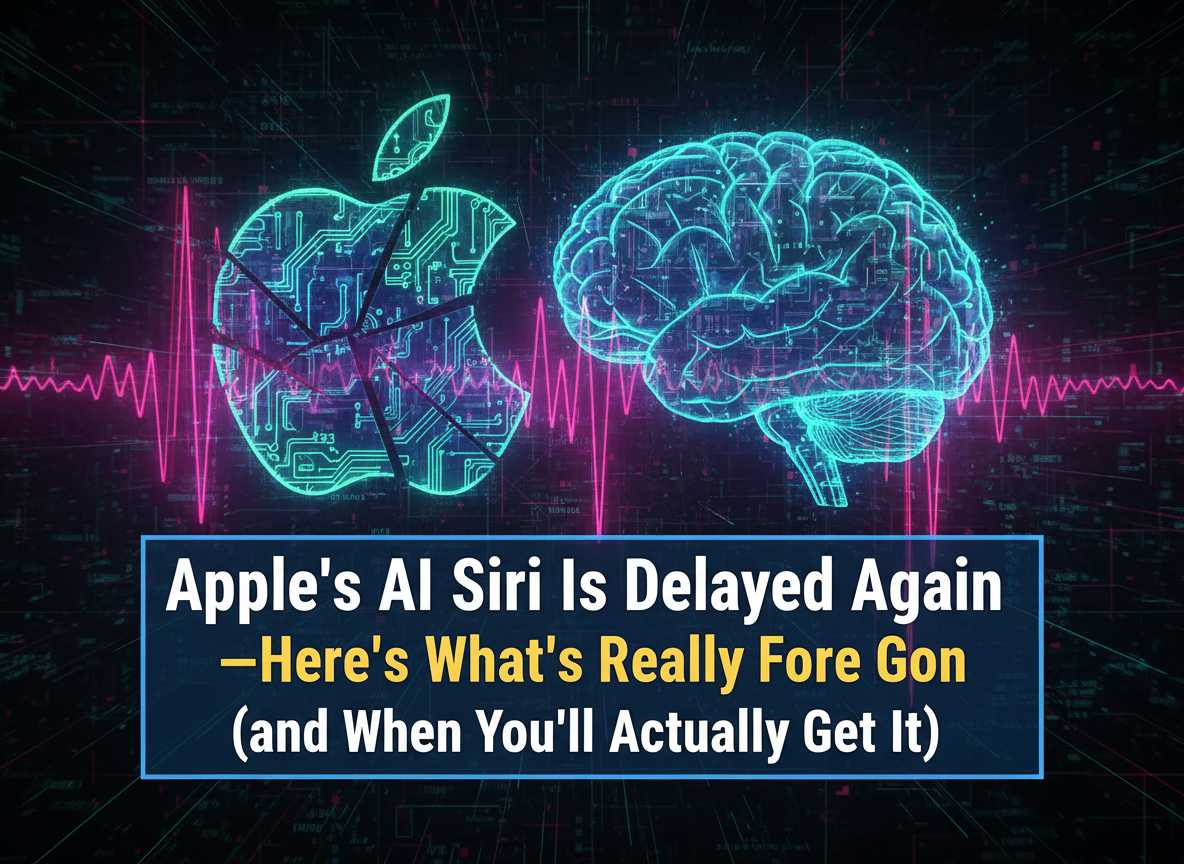
Apple just confirmed what everyone suspected: the new AI-powered Siri isn't coming in iOS 26.4.
Again.
We were supposed to get the "revolutionary" Siri update in iOS 26.4 (March 2026). But according to reports from MacRumors, 9to5Mac, and Bloomberg, Apple is pushing back the most important features until iOS 26.5 at the earliest—and some features won't arrive until iOS 27 in September 2026.
So what's going on? Why can't Apple—the company that literally invented the modern smartphone assistant—ship a competitive AI assistant when Google, Amazon, and OpenAI already did?
Let's break down what's actually happening inside Apple, why Siri is so far behind, and when you'll actually get the AI assistant you were promised.
What Apple Promised (and What You're Actually Getting)
First, let's clear up what we were supposed to get with the "new Siri."
The Original Promise (WWDC 2025):
Apple announced a complete Siri overhaul powered by AI, featuring:
- Conversational context (Siri remembers what you talked about)
- Onscreen awareness (Siri can see and act on what's on your screen)
- Cross-app actions (Siri can do complex tasks across multiple apps)
- Personalization (Siri learns your habits and preferences)
- Natural language understanding (Talk to Siri like a human, not a robot)
Basically, Siri would finally catch up to what Google Assistant could do in 2022.
What's Actually Shipping in iOS 26.4 (March 2026):
According to Apple's updated timeline:
- ✅ Basic conversational improvements (slightly better at understanding context)
- ✅ Some visual understanding (limited onscreen awareness)
- ❌ Full cross-app automation → Delayed to iOS 26.5 or iOS 27
- ❌ Advanced personalization → Delayed to iOS 26.5 or iOS 27
- ❌ Chatbot-style interactions → Delayed to iOS 27 (September 2026)
So iOS 26.4 gets you incremental improvements, not the revolutionary leap Apple teased. For more, see the Apple HomePad that's also waiting on Siri improvements.
What's Delayed Until iOS 26.5 (June-ish 2026):
- More cross-app workflows (e.g., "Find that email from John and add it to my calendar")
- Better personalization based on your usage patterns
- Improved accuracy and speed (more on this below)
What's Not Coming Until iOS 27 (September 2026):
- Chatbot functionality (Siri as a conversational AI like ChatGPT or Claude)
- Full app integration (deep automation across third-party apps)
- Gemini-powered features (Apple's rumored Google partnership for advanced AI)
Translation: The Siri you were promised won't fully arrive until at least September 2026—possibly later if Apple delays again (which they probably will).
Why Is Apple So Far Behind on AI Assistants?
Here's the uncomfortable truth: Apple is late to the AI party, and they know it.
While Google, Amazon, Microsoft, and OpenAI were shipping conversational AI assistants, Apple was... doing what, exactly? For more, see Apple's deal with Google Gemini to fill the Siri gap.
Let's look at the timeline:
- 2016: Google Assistant launches with conversational AI
- 2018: Alexa gets follow-up mode and better context awareness
- 2022: Google Assistant gets Look and Talk (sees you and responds without "Hey Google")
- 2023: ChatGPT and Claude launch, redefining what conversational AI can do
- 2024: Google integrates Gemini into Assistant, Microsoft ships Copilot everywhere
- 2026: Apple is still trying to ship what Google had in 2022
Apple isn't just behind. They're years behind.
So what happened?
Problem #1: Siri's Architecture Is Ancient (and Apple Knows It)
Siri was built in 2011. The underlying architecture hasn't fundamentally changed since then.
According to former Apple engineers (via Bloomberg and The Verge reports over the years), Siri's codebase is a tangled mess that's incredibly difficult to update:
- Hardcoded rules instead of flexible AI models
- Siloed functionality (every feature is a separate module that doesn't talk to the others)
- Slow processing pipeline (queries bounce between servers in ways that add latency)
Modernizing Siri isn't just adding new features—it's rebuilding the entire system from scratch.
That takes years, not months. And Apple started way too late.
Problem #2: Privacy Constraints Make Everything Harder
Apple's privacy-first approach is genuinely admirable. But it also makes AI assistants way harder to build.
Here's why:
- Google and Amazon train their assistants on billions of user interactions collected from real usage
- Apple can't (or won't) do that because of their privacy commitments
- Result: Apple has less training data, which means their AI models are less capable
To compensate, Apple has to:
- Build on-device AI models (harder to scale, limited by iPhone hardware)
- Partner with third parties like Google (Gemini) for cloud-based features (which goes against Apple's privacy ethos)
- Spend more time fine-tuning models with limited data
Privacy is a feature, but it's also a constraint. Apple chose this trade-off intentionally, but it's costing them years of development time.
Problem #3: It's Not Working Yet (Even Internally)
Here's the most damning detail from MacRumors' report:
"Employees testing iOS 26.5 say the update includes all of the features Apple promised, including personalization, onscreen awareness, and the ability for Siri to do more in and between apps, but not all of the features are working reliably and there are problems with accuracy. Additionally, Siri sometimes doesn't properly process queries and can take too long to respond to requests."
Translation: Even when Apple ships the "new Siri," it might not actually work well.
This is classic Apple: they won't ship something until it meets their quality bar. But that quality bar is delaying everything while competitors ship "good enough" AI that gets better over time.
Apple is perfecting instead of iterating. In the AI era, that's a losing strategy.
Problem #4: Apple Is Trying to Do Too Much at Once
Apple doesn't just want Siri to match Google Assistant. They want it to:
- Work entirely on-device (for privacy)
- Integrate deeply with iOS (onscreen awareness, cross-app actions)
- Support every language Apple ships in (not just English)
- Work perfectly out of the box (no "beta" excuses)
That's an impossibly high bar to clear all at once.
Google shipped Assistant as a beta, improved it over years, and still has reliability issues. Apple is trying to ship a finished product on day one.
Spoiler alert: It's not working.
What This Means for You (the iPhone User)
Okay, so Apple is behind and Siri is delayed again. What does that actually mean for your day-to-day iPhone experience?
If You're on iOS 26.4 (March 2026):
You'll get slightly better Siri:
- ✅ Marginal improvements in understanding context
- ✅ Basic visual awareness (Siri can see some things on your screen)
- ❌ Still can't automate complex workflows across apps
- ❌ Still not conversational like ChatGPT or Claude
Verdict: Siri will be less frustrating, but still not revolutionary.
If You Wait Until iOS 26.5 (Summer 2026):
You'll get meaningfully better Siri:
- ✅ Cross-app automation (e.g., "Find my flight confirmation and add it to my calendar")
- ✅ Personalization (Siri learns your habits)
- ✅ Better accuracy and speed (assuming Apple fixes the internal issues)
Verdict: This is where Siri might finally feel competitive with Google Assistant circa 2023.
If You Wait Until iOS 27 (September 2026):
You'll get the Siri Apple actually promised:
- ✅ Chatbot-style conversations (talk to Siri like ChatGPT)
- ✅ Deep app integration (Siri can do complex tasks automatically)
- ✅ Gemini-powered features (if Apple's partnership with Google ships)
Verdict: This is the real upgrade. Everything before this is just incremental.
Should You Just Use ChatGPT Instead?
Here's the awkward question no one at Apple wants to answer:
If Siri won't be good until September 2026... why not just use ChatGPT or Claude right now?
You can already:
- Add ChatGPT to your iPhone via the app (with Siri Shortcuts support)
- Use Claude for conversational AI that actually works
- Try Google Assistant on iOS (it's better than Siri, even on Apple's platform)
The only things Siri does better than third-party AI assistants:
- ✅ Deep iOS integration (control settings, open apps, send texts)
- ✅ Privacy (on-device processing, no data collection)
- ✅ Works offline (for basic tasks)
But for everything else—answering questions, having conversations, helping with complex tasks—third-party AI assistants are way ahead.
Apple knows this. That's why they're scrambling to catch up.
The Bottom Line: Don't Hold Your Breath
Here's my advice if you're waiting for the "new Siri":
If you're on iPhone 15 or newer:
- Update to iOS 26.4 when it ships (March 2026) for incremental improvements
- Don't expect magic—it'll be better, but not revolutionary
- Plan to wait until iOS 27 (September 2026) for the real upgrade
If you're on iPhone 14 or older:
- You probably won't get the new Siri anyway (it requires Apple Intelligence, which needs iPhone 15 or newer)
- Consider upgrading to iPhone 17e ($599, launches February 2026) if you want Apple Intelligence support
If you need a good AI assistant right now:
- Use ChatGPT (free app, works great on iPhone)
- Try Claude (conversational AI, excellent for complex tasks)
- Install Google Assistant (better than Siri, even on iOS)
Apple will eventually ship a competitive AI assistant. But "eventually" is looking like late 2026 at the earliest—and knowing Apple's track record with Siri, I wouldn't be shocked if key features slip into 2027.
In the meantime, don't wait. Use the AI tools that work today, not the ones Apple promises will work "soon. For more, see what iOS 27 promises for Siri and Apple Intelligence. "
Want to stay updated on Siri's development? Bookmark this page and check back when iOS 26.5 and iOS 27 ship. We'll have hands-on reviews, feature breakdowns, and real-world testing.