Apple's HomePad Smart Display Delayed to Fall 2026: Why Siri's AI Overhaul Is Holding Everything Back
Apple's long-rumored HomePad smart home display has been pushed to fall 2026, with its robot-arm sibling slipping to 2027. The culprit is Siri's ambitious AI overhaul, which still isn't ready. Here's everything we know and what it means for Apple's smart home future.
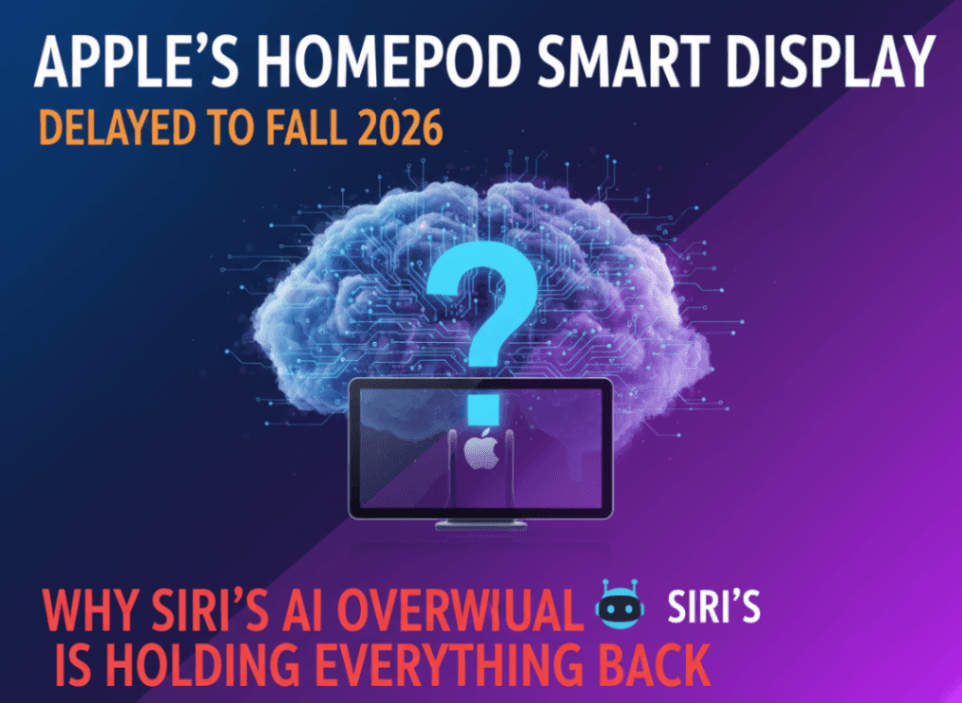
Apple fans have been waiting years for the company to enter the smart home display market — and they're going to keep waiting. According to a new report from Bloomberg's Mark Gurman, Apple's long-rumored smart home display (codenamed J490, and widely nicknamed "HomePad") has been pushed back yet again, this time to fall 2026. Meanwhile, its more ambitious sibling — a robot-arm-equipped tabletop device — won't arrive until 2027 at the earliest.
The reason for the holdup isn't hardware or manufacturing. It's Siri. Apple's virtual assistant is undergoing a sweeping AI overhaul that was supposed to debut by now, and the delay of that upgrade has created a cascading effect across multiple Apple product launches. The HomePad, in particular, was designed from the ground up to showcase the new, more intelligent Siri — and without that software foundation in place, the hardware simply isn't ready for prime time.
This is one of the most significant product delays in Apple's recent history, and it reveals a lot about the challenges the company faces in the post-ChatGPT era of artificial intelligence.
What We Know About Apple's HomePad Smart Display
The J490 has been the subject of Apple rumors for over two years. Described as a "HomePod with a screen," the device was initially pegged for a 2025 launch, then a spring 2026 release. Now, it's been pushed to fall 2026 — most likely alongside iOS 27 and Apple's annual hardware refresh cycle.
Leaker Kosutami first flagged the delay on X, and Gurman's Bloomberg report confirmed the news with additional detail. According to Gurman, the J490 is designed to function as a central hub for Apple's smart home ecosystem, combining the audio quality of a HomePod with a touchscreen display for video calls, smart home controls, and AI-driven interactions.
The device is expected to run a new software platform built specifically for the smart home form factor — think something between iPadOS and the Apple TV interface, but optimized for countertop use in a kitchen or living room. It will be deeply integrated with HomeKit, and will lean heavily on the updated Siri to handle complex, multi-step voice commands.
In terms of hardware specs, rumors point to an LCD or OLED touchscreen in the 6–7 inch range, Apple's own silicon (likely an A-series or S-series chip), a wide-angle front camera for FaceTime, and a speaker array comparable to the HomePod mini. Pricing speculation ranges from $199 to $299 — putting it squarely in the territory of Amazon's Echo Show 10 and Google's Nest Hub Max.
Why Siri's AI Overhaul Is the Real Bottleneck
To understand why the HomePad is delayed, you need to understand what Apple is trying to do with Siri — and why it's proving harder than expected. For more, see the broader story of why Siri keeps getting delayed.
For years, Siri has lagged behind competitors like Google Assistant and Amazon Alexa in terms of conversational AI capability. Apple acknowledged this publicly at WWDC 2024, unveiling a major Siri redesign powered by large language model (LLM) technology. The new Siri was promised to have better context awareness, the ability to take actions across apps, and deeper integration with personal data like emails, messages, and calendars.
But delivering on that promise at scale — across hundreds of millions of devices, in multiple languages, while maintaining Apple's strict privacy standards — has proven enormously complex. Key features announced in 2024 have seen repeated delays, and the chatbot-style conversational upgrade for Siri, which is central to the HomePad experience, is reportedly still in active development. For more, see iOS 27 and the Siri chatbot overhaul it brings. For more, see everything else Apple has planned for 2026.
Apple has staked the HomePad's entire value proposition on being smarter than any smart display on the market. A HomePad running a half-baked Siri would be worse than no HomePad at all — especially in a market where Amazon and Google have years of head start. So Apple is doing what it often does: waiting until everything is right before shipping.
According to Gurman, the updated Siri with LLM-powered conversational capabilities is now expected to launch alongside iOS 27 in the fall. That timeline aligns perfectly with the new HomePad window.
The Robot Arm Model: Apple's Most Ambitious Home Device Yet
If the HomePad is interesting, Apple's other smart home device — a robotic, iPad-mounted arm — is genuinely unlike anything on the market.
Described internally as a "tabletop robot," this device is essentially an iPad-style display mounted on a motorized arm that can physically track and orient toward whoever is speaking or moving in the room. Picture a home assistant that turns to face you when you walk in, adjusts its screen angle during video calls, and uses spatial awareness to understand where you are relative to it.
This device was previously rumored for a 2025 or 2026 launch, but Gurman's latest reporting places it in 2027. It's a significantly more complex product — both mechanically and from a software standpoint — and Apple is clearly taking a measured approach to development.
When it does arrive, the robot arm model is expected to be Apple's premium smart home offering, positioned above the J490 HomePad and priced accordingly. It's the kind of product that could define an entirely new category of home computing — and give Apple a foothold in the living room that no other product in its lineup currently provides.
Apple's Smart Home Ambitions in a Competitive Landscape
Apple entering the smart home display market isn't just a product launch — it's a strategic statement. Amazon's Echo Show lineup and Google's Nest Hub series have dominated this category for years, and both companies have used their displays to deepen user lock-in to their respective ecosystems.
Apple has always had the ingredients for a compelling smart home story: HomeKit, Apple TV, HomePod, and a billion-device installed base of iPhones and iPads. What it has lacked is a dedicated always-on display hub that ties it all together and serves as the command center of the connected home.
The J490 HomePad is designed to fill that gap. But Apple is entering a market where consumer expectations are already high. Amazon and Google have had years to iterate on their hardware and AI experiences, and both have recently doubled down on generative AI features for their smart displays. Apple will need to offer something meaningfully better — not just comparable — to convince users to add a HomePad to their existing setup.
The bet Apple is making is that a truly intelligent Siri, backed by Apple's privacy-first approach to on-device AI, will be that differentiator. The pitch: "Amazon and Google send your data to the cloud. Apple processes it on your device." Whether that messaging resonates will depend heavily on how polished and capable the new Siri actually is at launch.
What This Means for Consumers Right Now
For consumers eagerly awaiting the HomePad, the fall 2026 timeline means at least six more months of patience. That's frustrating — but the delay may ultimately be the right call.
Apple products that launch before they're ready face intense scrutiny and can damage brand perception in lasting ways. A HomePad that showcases a polished, genuinely useful Siri AI at launch will land far better than one shipping with half-baked voice commands and placeholder AI features. Apple learned this lesson the hard way with the initial Apple Intelligence rollout, and the company seems determined not to repeat the experience.
For those in the market for a smart home display today, the choice remains between Amazon's Echo Show lineup and Google's Nest Hub Max. But if you're deeply embedded in Apple's ecosystem — iPhone, iPad, Mac, Apple TV, and HomePod — it may be worth holding off to see what fall 2026 brings. The potential for seamless, privacy-respecting integration across all those devices is a genuinely compelling offer that Amazon and Google simply can't match.
One thing is certain: Apple's arrival in the smart home display market is going to change it. Competitors are already accelerating their AI development in anticipation, and the bar for what consumers expect from smart home displays keeps rising.
Conclusion
Apple's HomePad smart display delay is ultimately a story about the demands of modern AI development. Building a genuinely intelligent virtual assistant — one that can hold conversational context, take meaningful actions across apps, and do so privately and reliably at scale — is far harder than it looks. Apple is refusing to ship until it gets Siri right, and the HomePad is waiting in the wings as a result.
Fall 2026 is the new target. If the Siri overhaul lands as promised alongside iOS 27, the HomePad could be one of the most anticipated Apple product launches in years. If it slips again, it will raise serious questions about Apple's AI roadmap — and hand Amazon and Google even more time to extend their smart home leads.
The smart home display wars are about to get a lot more interesting. Apple is coming — just not quite yet.
Frequently Asked Questions
Q: What is Apple's HomePad smart display? A: Apple's HomePad (internally codenamed J490) is a rumored smart home display device — essentially a HomePod with a touchscreen — designed to serve as a central hub for Apple's smart home ecosystem. It's expected to feature FaceTime capabilities, HomeKit smart home controls, and a deeply integrated, AI-powered Siri built on large language model technology.
Q: Why has Apple's smart home display been delayed to fall 2026? A: According to Bloomberg's Mark Gurman, the HomePad is waiting for Apple to complete a major AI overhaul of Siri. The new, LLM-powered Siri is a core part of the HomePad's value proposition, and Apple doesn't want to launch the hardware until the software experience meets its standards. The updated Siri is now expected to arrive alongside iOS 27 in fall 2026.
Q: When will Apple's robot arm smart home device launch? A: Apple's tabletop robot device — a motorized, iPad-style display mounted on a robotic arm that tracks movement around the room — has been pushed to 2027, according to the latest reports from Mark Gurman at Bloomberg. It's a significantly more complex product than the standard HomePad and represents Apple's premium smart home vision for the years ahead.