iOS 27: Siri Chatbot, iPhone Fold Support & Every Feature Coming to India
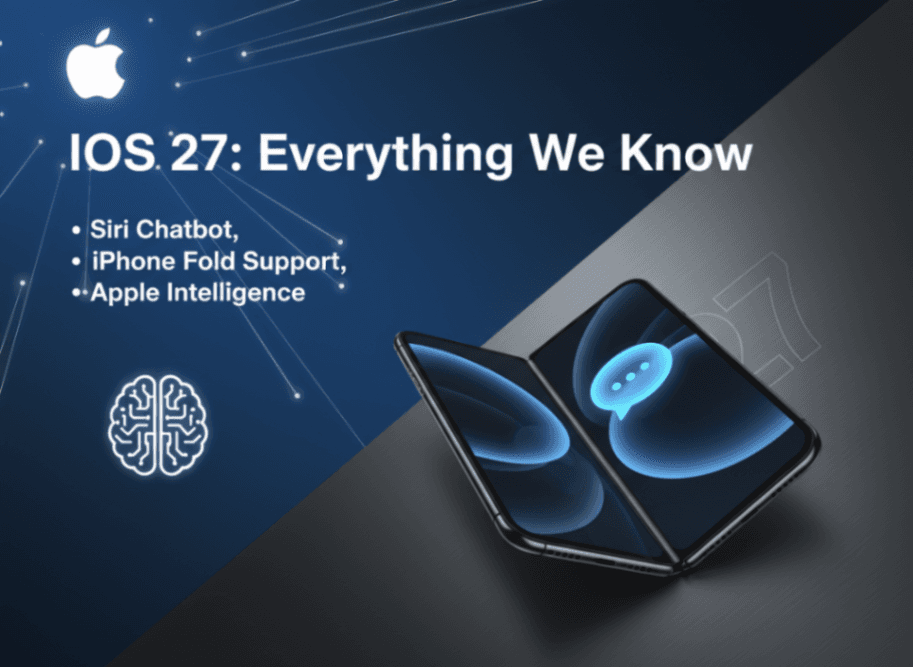
iOS 27 is shaping up to be Apple's biggest software release in years. From a completely rebuilt Siri chatbot to iPhone Fold support, Apple Intelligence upgrades, and a landmark Apple-Google Gemini partnership - here's everything we know.
Apple's annual iOS update cycle has produced some memorable releases - iOS 7's visual overhaul, iOS 12's performance focus, iOS 16's lock screen customization. But iOS 27 is shaping up to be something different: a fundamental rethinking of what Apple's operating system can do in the age of artificial intelligence, paired with the most significant hardware expansion in iPhone history. For more, see Apple HomePad's delayed Siri AI overhaul. For more, see why Apple's Siri AI features keep getting delayed.
Here is everything we know about iOS 27, from Siri's complete transformation to the landmark Apple-Google Gemini partnership.
Siri Gets a Complete Overhaul: Meet the Siri Chatbot
Siri has been Apple's Achilles' heel for years. While Google Assistant and ChatGPT redefined what AI assistants could do, Siri remained frustratingly literal, prone to failure, and limited in its conversational abilities. iOS 27 changes that entirely.
Apple is rebuilding Siri from the ground up as a conversational AI chatbot - not just a command executor. The new Siri in iOS 27 features:
Extended Conversational Memory: Siri can now remember context across a conversation for up to 50 exchanges, allowing you to build on previous questions naturally. Ask Siri to plan a trip, and it remembers your preferences from earlier in the conversation without requiring you to repeat yourself.
Proactive Suggestions: The new Siri doesn't wait to be asked. It surfaces relevant suggestions based on your calendar, messages, location, and habits - before you think to ask. Heading to a meeting? Siri proactively pulls up the relevant document.
Deep App Integration: Siri in iOS 27 can perform complex multi-step actions across apps. "Move my 3pm meeting to tomorrow, send an apology to the attendees, and book me a lunch spot near the office" - all in a single request.
Natural Language Understanding: The new Siri is trained on a dramatically expanded dataset, making it significantly more capable of understanding indirect, ambiguous, and colloquial requests.
Apple's own Large Language Model - developed by the Apple Intelligence team - powers the core Siri chatbot, with optional routing to third-party models for certain queries.
The Apple-Google Gemini Partnership
The biggest iOS 27 story is not a feature - it is a partnership that nobody saw coming.
Apple and Google have agreed to integrate Google's Gemini AI models into iOS 27 as an optional extension of Apple Intelligence. This is the most significant commercial AI deal in tech history, and it represents a remarkable evolution of the two companies' relationship - longtime rivals now collaborating on AI.
The partnership works as follows: By default, Siri and Apple Intelligence handle requests on-device or via Apple's Private Cloud Compute infrastructure. For complex queries that require deeper web knowledge, reasoning, or real-time information, users can optionally route requests to Gemini Pro - Google's most capable AI model.
Importantly, Apple has negotiated strict privacy terms. When a request is routed to Gemini, it is anonymized and stripped of personally identifiable information before leaving the device. Google cannot use these queries for ad targeting, model training, or any commercial purpose beyond answering the request.
The Gemini integration is opt-in and transparent - users see when a query is being handled by Gemini vs. Apple Intelligence. This approach mirrors Apple's existing ChatGPT integration, extended to Google's model as well.
Why Google? Apple reportedly evaluated all major AI providers and concluded that Gemini's multimodal capabilities - particularly its ability to analyze images, documents, and live video - make it the best complement to Apple Intelligence's on-device strengths.
iPhone Fold Support: A New Software Paradigm
With the iPhone Fold arriving in fall 2026, iOS 27 introduces an entirely new software paradigm for foldable devices. For more, see the iPhone Fold that iOS 27 was built around.
Apple calls it Adaptive Layout - a system-wide framework that allows every iPhone app to seamlessly adapt between the cover display and the expanded inner display. Developers can target three form factors in their apps:
- Compact: Standard iPhone layout for the cover display and folded mode
- Regular: Expanded layout for the unfolded inner display
- Split: Dual-pane layout for running two instances of the same app side by side
All existing App Store apps will automatically adapt using Apple's intelligent layout engine, even without developer updates. Apps built with SwiftUI - Apple's modern UI framework - get full Adaptive Layout support automatically.
The iPhone Fold's signature multitasking features, including Split View and Stage Manager (yes, Stage Manager is coming to iPhone with Fold support), are implemented at the iOS 27 level, meaning they benefit from the same tight integration as iPadOS multitasking.
Apple is also introducing App Continuity as a system feature: when you unfold the iPhone Fold, whatever app you were using on the cover display expands seamlessly to fill the inner display - no interruption, no reload.
Apple Intelligence 2.0: What's New
Apple Intelligence, introduced in iOS 18, gets a significant upgrade in iOS 27. Here is what's new:
Image Intelligence: The Visual Intelligence camera feature, first introduced with iPhone 16, is expanded dramatically. Point your camera at a restaurant, product, plant, animal, or landmark - iOS 27 provides rich contextual information, comparisons, and actions in real time.
Priority Inbox: Apple Intelligence now manages your Mail inbox with GPT-4 level comprehension, automatically triaging messages, summarizing long threads, and drafting replies that actually sound like you.
Personal Context Engine: Apple Intelligence builds a private, on-device model of your preferences, habits, and communication style. This model powers more personalized suggestions, writing assistance, and Siri responses - without any data leaving your device.
Live Translation: Real-time translation comes to Phone calls, FaceTime, and Messages in iOS 27. Speak in English; your contact hears Mandarin. This feature uses on-device processing to ensure call privacy.
Code Interpreter: For developers, Apple Intelligence can analyze, explain, and debug Swift code directly in Xcode, with suggestions that understand your project's full context.
Other Major iOS 27 Features
Beyond AI, iOS 27 brings significant quality-of-life improvements:
- Redesigned Control Center: Fully customizable with resizable widgets, an expanded quick-action grid, and per-app control panels
- RCS Enhancements: Richer RCS messaging with end-to-end encryption for cross-platform group chats with Android users
- Satellite Messaging 2.0: Expanded satellite connectivity for data, not just emergency SOS
- HomeKit Matter 2.0: Faster, more reliable smart home integration across platforms
- Safari Intelligence: AI-powered reading mode that summarizes articles, answers questions about page content, and highlights key facts
- Fitness+ AI Coach: Personalized workout recommendations that adapt to your health data
When Is iOS 27 Coming?
Apple is expected to preview iOS 27 at WWDC in June 2026, with developer beta available immediately following the keynote. Public beta should follow in July 2026, with the final release shipping alongside the iPhone 17 lineup in September 2026.
The iPhone Fold-specific features - including Adaptive Layout and Stage Manager for iPhone - will launch alongside the iPhone Fold in September 2026.
iOS 27 is expected to support iPhone 16 and newer, with full Apple Intelligence features requiring iPhone 17e, 17, 17 Plus, 17 Pro, or 17 Pro Max, or iPhone Fold.
Conclusion
iOS 27 is not an incremental update. It is Apple's most ambitious operating system since iOS 7 - a complete rethinking of Siri, a landmark AI partnership with Google, iPhone Fold support that redefines what a smartphone OS can be, and a second generation of Apple Intelligence that genuinely delivers on the promise of AI-powered computing.
If these features land as described, iOS 27 will make the fall 2026 iPhone lineup the most compelling in Apple's history. And with the MacBook Neo, iPhone Fold, and iPhone 17e all launching in the same year, Apple is entering its most transformative period in a decade.
Frequently Asked Questions
Q: What is the Apple-Google Gemini partnership in iOS 27? A: Apple has integrated Google's Gemini AI models as an optional extension of Apple Intelligence. Users can opt in to route complex queries to Gemini Pro, with strict privacy protections ensuring data is anonymized before leaving the device.
Q: Will iOS 27 support older iPhones? A: iOS 27 is expected to support iPhone 16 and newer. Full Apple Intelligence features, including the new Siri chatbot and Gemini integration, require iPhone 17 series or newer due to processing requirements.
Q: When will the iPhone Fold multitasking features come to regular iPhones? A: Stage Manager and full Split View as implemented on the iPhone Fold are exclusive to that device. Standard iPhones will receive other iOS 27 multitasking improvements, but the iPad-class features require the Fold's larger inner display.