iPhone 17 Air vs 17 Pro: Best Pick for India (2026)
iPhone 17 Air vs iPhone 17 Pro compared for Indian buyers in 2026. Full specs, camera, battery, and pricing breakdown from Rs 1,19,900 to help you decide.
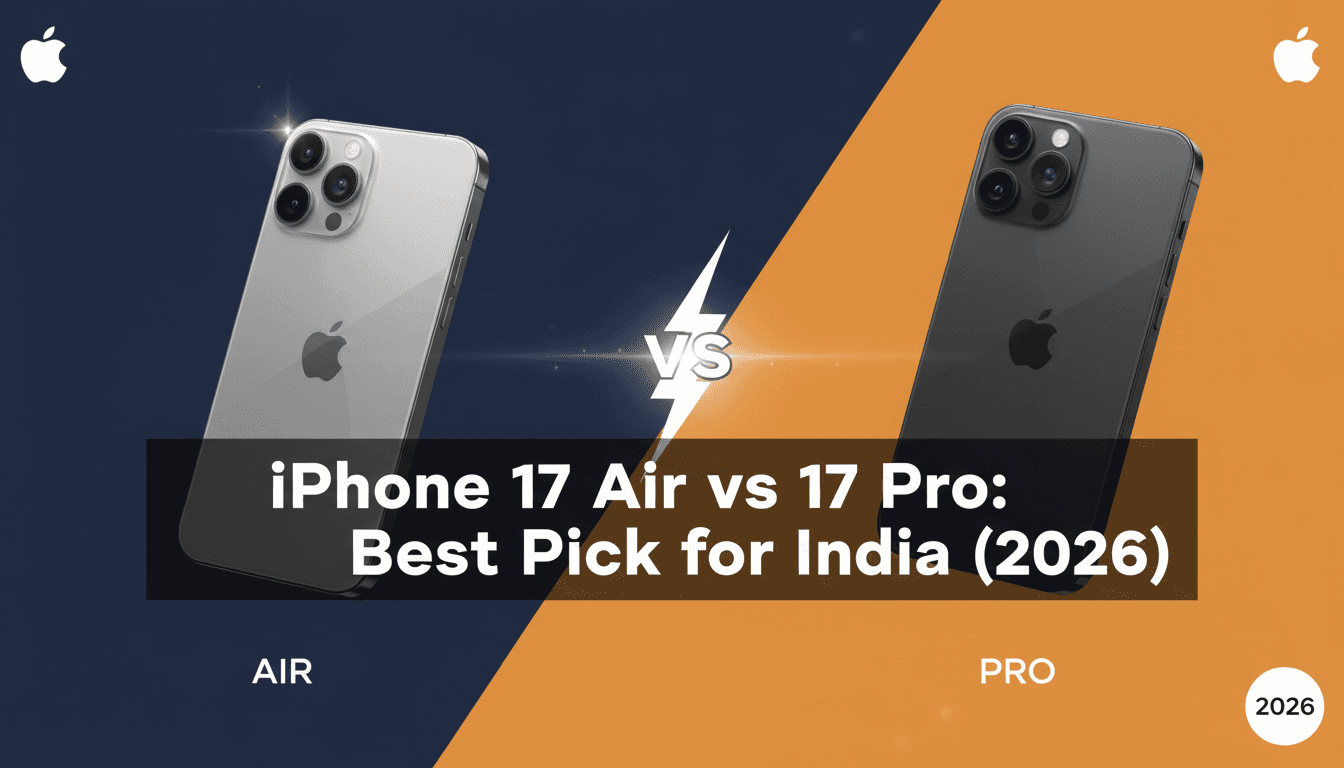
The iPhone 17 Air and iPhone 17 Pro sit at opposite ends of Apple's 2026 flagship spectrum. One is the thinnest iPhone ever made. The other packs a triple-camera system and the longest Pro battery life yet. Both run the A19 Pro chip, both support Apple Intelligence, and both cost over a lakh in India.
So which one deserves your money? This head-to-head comparison breaks down every difference that matters for Indian buyers — from pricing and camera quality to battery life and real-world performance.
iPhone 17 Air vs iPhone 17 Pro: Price in India
The price gap between these two phones tells you a lot about who Apple designed them for.
- iPhone Air (256GB): ₹1,19,900
- iPhone Air (512GB): ₹1,29,900
- iPhone Air (1TB): ₹1,49,900
- iPhone 17 Pro (256GB): ₹1,34,900
- iPhone 17 Pro (512GB): ₹1,54,900
- iPhone 17 Pro (1TB): ₹1,74,900
The base iPhone Air starts ₹15,000 cheaper than the base iPhone 17 Pro. That is a meaningful gap when you are already spending over a lakh. For context, ₹15,000 covers a pair of AirPods or a year of iCloud+ storage.
India continues to have some of the highest iPhone prices globally. The same iPhone 17 Pro that costs $1,099 in the US (roughly ₹96,900) retails for ₹1,34,900 here — a premium of nearly ₹38,000. If you are considering buying from Dubai or Hong Kong, the savings can be substantial.
Design: Ultra-Thin vs Camera-Ready
The iPhone Air is Apple's design statement. At just 5.64mm thick and 165 grams, it is the thinnest and lightest iPhone Apple has ever shipped. Holding one feels closer to an iPad mini than a traditional iPhone. The single-camera cutout on the rear keeps the design clean and minimal.
The iPhone 17 Pro takes the opposite approach. At 8.75mm thick and 206 grams, it is noticeably heavier and chunkier. The horizontal camera bump across the back houses a triple-lens system. Apple switched from titanium to an aluminium frame this year, which some users may find less premium in hand.
Key design differences:
- iPhone Air: 5.64mm thick, 165g, titanium frame, single rear camera, no physical SIM
- iPhone 17 Pro: 8.75mm thick, 206g, aluminium frame, triple rear camera, eSIM only
Both phones come with Ceramic Shield 2 protection, IP68 water resistance, and peak brightness of 3,000 nits. Both also include the Action Button and Camera Control Button.
The iPhone Air ships in space black, cloud white, light gold, and sky blue. The iPhone 17 Pro comes in silver, cosmic orange, and deep blue.
Display: Bigger Screen vs Compact Pro
Here is where things get interesting. The iPhone Air actually has a larger display than the Pro.
- iPhone Air: 6.5-inch OLED, 2736 x 1260 pixels, 120Hz
- iPhone 17 Pro: 6.3-inch OLED, 2622 x 1206 pixels, 120Hz ProMotion
Both panels hit 460 PPI and support the full 1-120Hz adaptive refresh range. In daily use, the screens look nearly identical in colour accuracy and sharpness. The Pro does have ProMotion branding, but both displays use LTPO technology with the same adaptive refresh behaviour.
If you prefer a bigger screen for streaming or scrolling, the iPhone Air actually wins here. The 6.5-inch panel makes media consumption noticeably better compared to the Pro's 6.3-inch display.
Performance: Same Chip, Different Modems
Both phones run the Apple A19 Pro chip with 12GB of RAM. Whether you are editing 4K video, running Apple Intelligence features, or multitasking between apps, performance will be identical.
The interesting difference is under the hood. The iPhone Air uses Apple's custom C1X modem — the second generation of Apple's in-house cellular chip. The iPhone 17 Pro uses the standard Apple N1 connectivity chip with Wi-Fi 7, Bluetooth 6, and Thread support.
Early reports suggest the C1X modem delivers slightly better 5G efficiency and signal retention in low-coverage areas, which could matter in Indian cities where 5G coverage remains spotty with Jio and Airtel networks.
Both phones support dual eSIM (no physical SIM tray), which works well with Jio and Airtel eSIM activation that most Indian carriers now support.
Camera: One Lens vs Three
This is the biggest difference between the two phones, and it is the reason most people will choose the Pro.
iPhone Air camera:
- 48MP wide rear camera (single lens)
- 18MP front camera
- 4K video recording
iPhone 17 Pro camera:
- 48MP wide + 48MP ultrawide + 48MP telephoto (8x optical zoom)
- 18MP front camera
- 4K video recording with ProRes RAW and Genlock support
The iPhone Air's single 48MP sensor takes excellent photos in good light. Apple's computational photography does heavy lifting, and casual shooters will be perfectly happy. But there is no ultrawide for group shots or landscapes, and no telephoto for zoomed-in shots of your kid's school event or a cricket match.
The iPhone 17 Pro's triple 48MP system is genuinely versatile. The 8x optical zoom (with digital zoom up to 40x) means you can capture details from a distance that the Air simply cannot match. ProRes RAW recording makes the Pro a legitimate tool for video creators.
Bottom line on cameras: If you mostly take photos of food, documents, and selfies, the Air is fine. If you care about photography flexibility — zoom, ultrawide, low-light performance — the Pro is worth the premium.
Battery Life: Slim Means Sacrifices
Physics does not care about marketing. A thinner phone means a smaller battery.
- iPhone Air: Up to 27 hours video playback, 22 hours streaming
- iPhone 17 Pro: Up to 33 hours video playback, 30 hours streaming
That is a six-hour gap in video playback — roughly 22% more battery life on the Pro. In real-world usage across a full Indian workday (heavy WhatsApp, some YouTube, maps navigation, and UPI payments), expect the Air to need a top-up by evening while the Pro comfortably lasts into the night.
The Air does have a clever trick: Apple's MagSafe Battery (sold separately) extends playback to 40 hours. But that adds bulk and cost, somewhat defeating the purpose of buying the thinnest iPhone.
Both phones support fast charging — the Pro hits 50% in 20 minutes with a 40W cable, while the Air takes 30 minutes with a 20W cable to reach the same mark.
Apple Intelligence and Software
Both phones run iOS 26 with full Apple Intelligence support. Features like Writing Tools, Image Playground, notification summaries, and the upgraded Siri work identically on both devices.
The A19 Pro chip with 12GB RAM ensures neither phone will be left behind when Apple rolls out new iOS 27 features later. Both are future-proofed for at least 5-6 years of software updates based on Apple's track record.
Apple Intelligence availability in India has been improving since the initial delays, with most features now working when the device language is set to English (India).
Storage Options
- iPhone Air: 256GB, 512GB, 1TB
- iPhone 17 Pro: 256GB, 512GB, 1TB
The Air actually matches the Pro on storage tiers this year. No expandable storage on either, so pick your capacity wisely. For most Indian users, 256GB is sufficient unless you shoot a lot of 4K video. The 1TB option exists mostly for professionals and content creators.
Who Should Buy the iPhone Air?
The iPhone Air is built for people who value design and portability above all else. Buy it if:
- You want the lightest, thinnest iPhone possible
- You primarily use your phone for calls, messaging, social media, and streaming
- Camera versatility (zoom, ultrawide) does not matter to you
- You are upgrading from an iPhone 14 or older and want a modern flagship experience
- You carry a MagSafe Battery anyway and do not mind the workaround for battery life
The Air is also a solid pick if you already own a dedicated camera or use an iPad for content creation. Not every phone needs to be a camera system.
Who Should Buy the iPhone 17 Pro?
The iPhone 17 Pro is the no-compromise choice for users who want the best iPhone experience without going Pro Max. Buy it if:
- Camera quality and versatility matter to you (zoom, ultrawide, ProRes)
- You need all-day battery life without carrying accessories
- You create content — video, photography, social media
- You want the most capable iPhone in a compact 6.3-inch form factor
- Battery anxiety is real for you (the Pro's 33-hour rating is genuinely impressive)
For Indian buyers specifically, the Pro's camera versatility shines at weddings, festivals, and family events where you need both wide and zoomed shots without switching devices.
The Verdict: ₹15,000 Buys You a Lot
For ₹15,000 more, the iPhone 17 Pro gives you:
- Triple camera system vs single camera
- 6 extra hours of video playback
- Faster wired charging
- ProRes RAW video recording
- A more traditional (and proven) phone form factor
The iPhone Air gives you:
- The thinnest iPhone ever made (5.64mm)
- A larger 6.5-inch display
- Apple's C1X modem with better 5G efficiency
- 41 grams lighter weight
- ₹15,000 savings
If you can stretch your budget, the iPhone 17 Pro is the better buy for most Indian users. The camera system alone justifies the premium, and the battery life advantage means you will not be hunting for chargers at the office or during your commute.
But if design is your priority and you are not a photography enthusiast, the iPhone Air is a genuinely beautiful phone that does not compromise on performance. It is the iPhone for people who treat their phone as a communication device first and a camera second.
Either way, you are spending over a lakh. If you are coming from an older iPhone, check our iPhone 17e comparison for a budget-friendly alternative that starts much lower.
Frequently Asked Questions
Is the iPhone 17 Air worth buying over the iPhone 17 Pro in India?
The iPhone Air is worth buying if you prioritise design and portability over camera versatility. At ₹1,19,900 for the 256GB model, it offers the same A19 Pro chip and Apple Intelligence features as the Pro but in a 5.64mm ultra-thin body. However, the single rear camera and smaller battery mean you sacrifice zoom photography and all-day battery life. For most Indian buyers who value camera flexibility and battery endurance, the ₹15,000 premium for the Pro is a better investment.
Does the iPhone Air have the same processor as the iPhone 17 Pro?
Yes, both the iPhone Air and iPhone 17 Pro run the Apple A19 Pro chip paired with 12GB of RAM. Performance in apps, games, and Apple Intelligence features is identical across both devices. The only hardware difference in connectivity is that the Air uses Apple's custom C1X modem while the Pro uses the N1 chip, though both support 5G, Wi-Fi 7, and dual eSIM.
Which iPhone 17 model has the best battery life for Indian users?
The iPhone 17 Pro offers significantly better battery life with up to 33 hours of video playback compared to the iPhone Air's 27 hours. In a typical Indian usage pattern involving WhatsApp, YouTube, UPI apps, and navigation, the Pro comfortably lasts a full day while the Air may need a top-up by evening. If battery life is a dealbreaker, the Pro (or Pro Max at 39 hours) is the clear winner.